



Our collaborative research and writing process began in the summer of 2019 during an in-person, relatively immersive week of developing a driving question, determining our research plan, and getting lots of suggestions and feedback from the seminar leaders and other seminar participants. We made ample use of whiteboards and gave special preference to the purple dry erase marker!
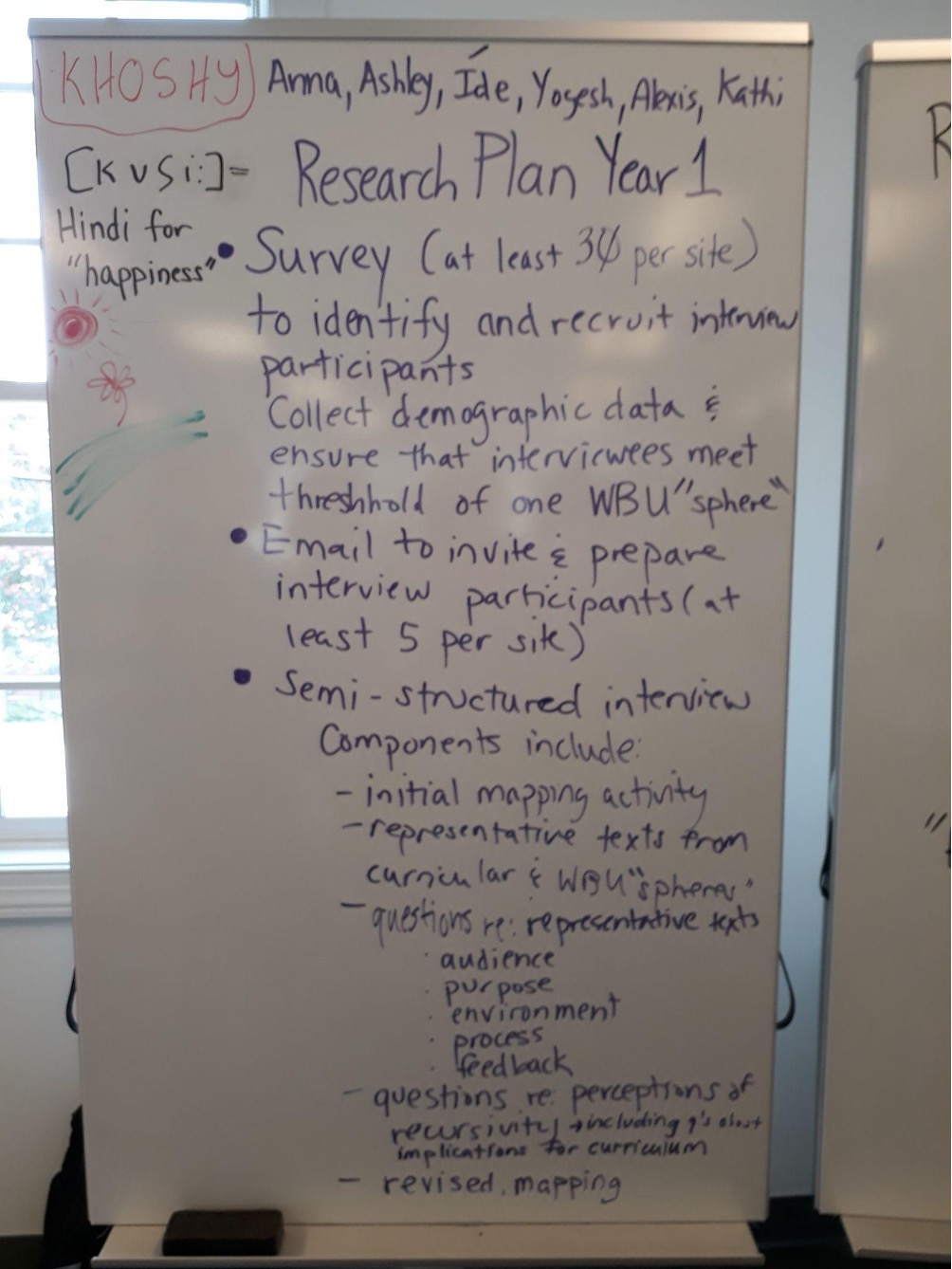
Image of Our Team’s Year 1 Research Plan Written in Purple Ink on a Whiteboard
We knew that our first year of collaboration would be focused on gathering data, and we had every expectation that we would reconvene the following summer at Elon to begin processing our data and writing up our results. As Kathi mentions, before we left Elon that first summer,
One of the things we made clear at the beginning of our collaboration was what the rules of the road were in those terms: so we each contributed a data set [surveys & interviews]... and the question was, ‘Can I take those data and use it for a single-authored piece? And if I can, how would that work?’ And so we have a procedure… we have a protocol, so we all know what the rules of the road are. And that seemed like a good thing to do. [LINK TO KY VIDEO]
Throughout the Fall of 2019 and early Spring of 2020, we checked in occasionally via email and video chat, updating each other on the progress of our IRB approvals, our survey responses, and our scheduled interviews. And then COVID happened! Not only did COVID disrupt our data collection, moving our interviews from in-person to remote, but it precluded us from all meeting in person until we presented our research at the International Writing Across the Curriculum (IWAC) Conference in the summer of 2023 (see pictures of our team at IWAC in the Playfulness section).
Unlike our first intensive in-person Elon Summer Seminar experience, our second summer “attending” the seminar was fully remote, and we gave this feedback to the seminar leaders, “Our team discussed how we felt that, even though we were able to accomplish many tasks through our virtual week, we really were at a disadvantage trying to work fully online, across multiple time zones, and juggling the demands of life at home.” Despite those very real disadvantages, we continued to collaborate using the twenty-first century digital technologies that facilitate collaboration when the human collaborators are physically distanced, such as a shared digital space on Microsoft Teams in which to store our data and documents (including our “to do” list/calendar, relevant published research, and writing in progress).
In his research on collaboration, Duffy (2021) draws attention to the trend of “teachers, researchers, and other literary professionals” who, when they “discuss collaboration or otherwise try to explain it as a particular kind of practice distinct from the work of solo writing, they often focus on the interpersonal dynamics collaborators must negotiate and how these dynamics relate to and inform the procedural work of coauthorship, like developing a work plan, sticking to a schedule, delegating tasks, and so forth” (5). As our team wrote together, we did create plans and we did delegate tasks by each taking primary responsibility for drafting a particular portion of the publication, either individually or with a partner.
Duffy also points to a gap in the current discussions of scholarly collaboration, noting “there is usually little said in these discussions about what the actual writing in collaborative writing entails” (5). As we wrote together, our team most often wrote collaboratively on shared documents, and when we met virtually, we would all be looking at the same document in real time and could record our observations and discussions to review later, if need be. As Kathi notes, during our writing and revisions, we used “A lot of track changes; a lot of versioning” as we melded our individual contributions into cohesive documents.
One of the main suggestions that Julien and Beres (2019) offer to scholars interested in participating in a writing group is to “be clear about their goals, revisit their goals, and be tenacious about meeting those goals…. it is crucial to align each aspect of a writing group with its goals, particularly the in-meeting and between-meeting activities” (13). Throughout our years-long collaborations, we often discussed our goals for written publications and conference presentations, and we set deadlines for each of our individual and shared contributions. Having set deadlines was important, even if we occasionally had to revise them, as they kept us accountable to each other and ensured that we, at a minimum, checked in with each other about our progress.
In their studies of collaborative writing, Lunsford & Ede (1986) found that “procedural strategies or patterns are very important,” and they identified “a number of variables which seem related to the degree of satisfaction experienced by those who typically write with one or more people,” including “the way credit (either direct as in a name on a title page, or indirect as in a means of advancement within an organization) is assigned” (75). Because we were very mindful of the variations among our team members with regard to seniority and institutional context, we had a discussion about “in what order do you list the authors, and why is it that order? And what difference, if any, that makes” early in our collaborative process. We kept in mind, for example that “[c]ollaborating authors often list their names in alphabetical order on publications in order to downplay differences of knowledge, power, or academic rank” (Kirsh, qtd. In Yancey & Spooner 57). We also considered how we could be strategic and capitalize on, or play up, the benefit of listing Kathi (the most well-known scholar in the field among our research team members) as the first author, as we did for our chapter in the collection edited by the Elon “Writing Beyond the University” Summer Seminar leaders and published by the Elon Center for Engaged Learning. For our article in the journal Writing Across the Curriculum, we agreed to list Ashley as the first author because she was seeking to deepen her scholarly contributions in that area because of her administrative role as WAC Director, and she agreed to take the lead on framing the question and corresponding with the editorial team. Similarly, Íde took the lead on our Composition Forum article and is therefore listed as first author on that publication.
In addition to the professional benefits we have garnered from our collaboration, we have enjoyed integrating the personal with the professional, as well.