



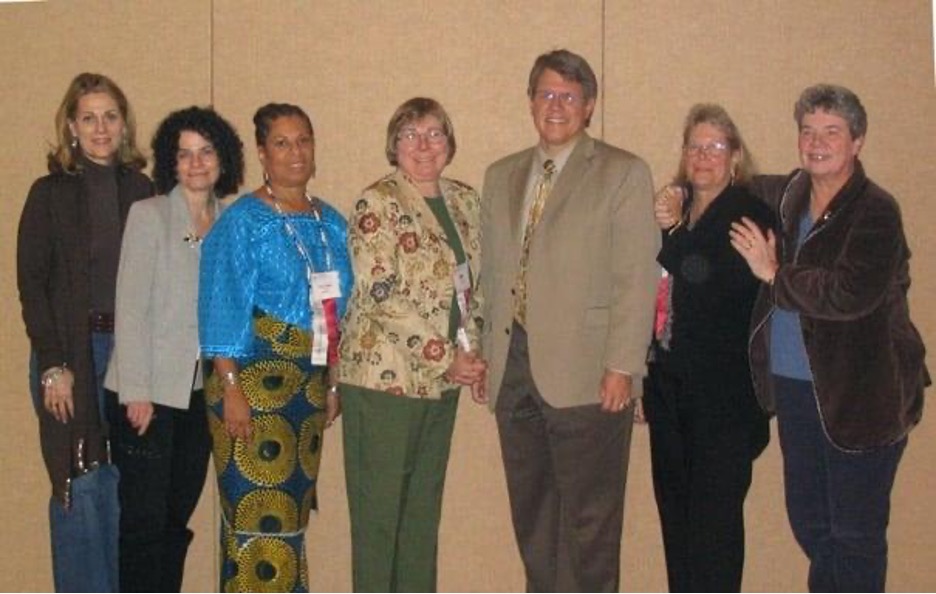
CCCC Officers 2006. Cheryl Glenn, Deb Holdstein, Duku Anoye, Jay Wooten, Doug hesse, Kathi Yancey, Carol Rutz
In 1984, I was in the middle of my PhD program at Iowa, married, with two kids, and in a rush toward a tenure track job, having left a full-time position. So, during my three years to degree, I forewent most opportunities for the valuable “extras” of grad school: parties, readings, late afternoon drinks. But when John Harper, a professor who’d helped me get a professional writing internship, invited me to lunch with John Gerber, I happily said yes. Gerber was a legendary figure, a founder of CCCC and its first chair, longtime English department chair at Iowa, by then retired. We ate in the River Room of the Iowa Memorial Union. I can’t recall what we linkage talked about, though I expect, given Harper’s interests, it involved musical theatre. I was just happy to be with living history.
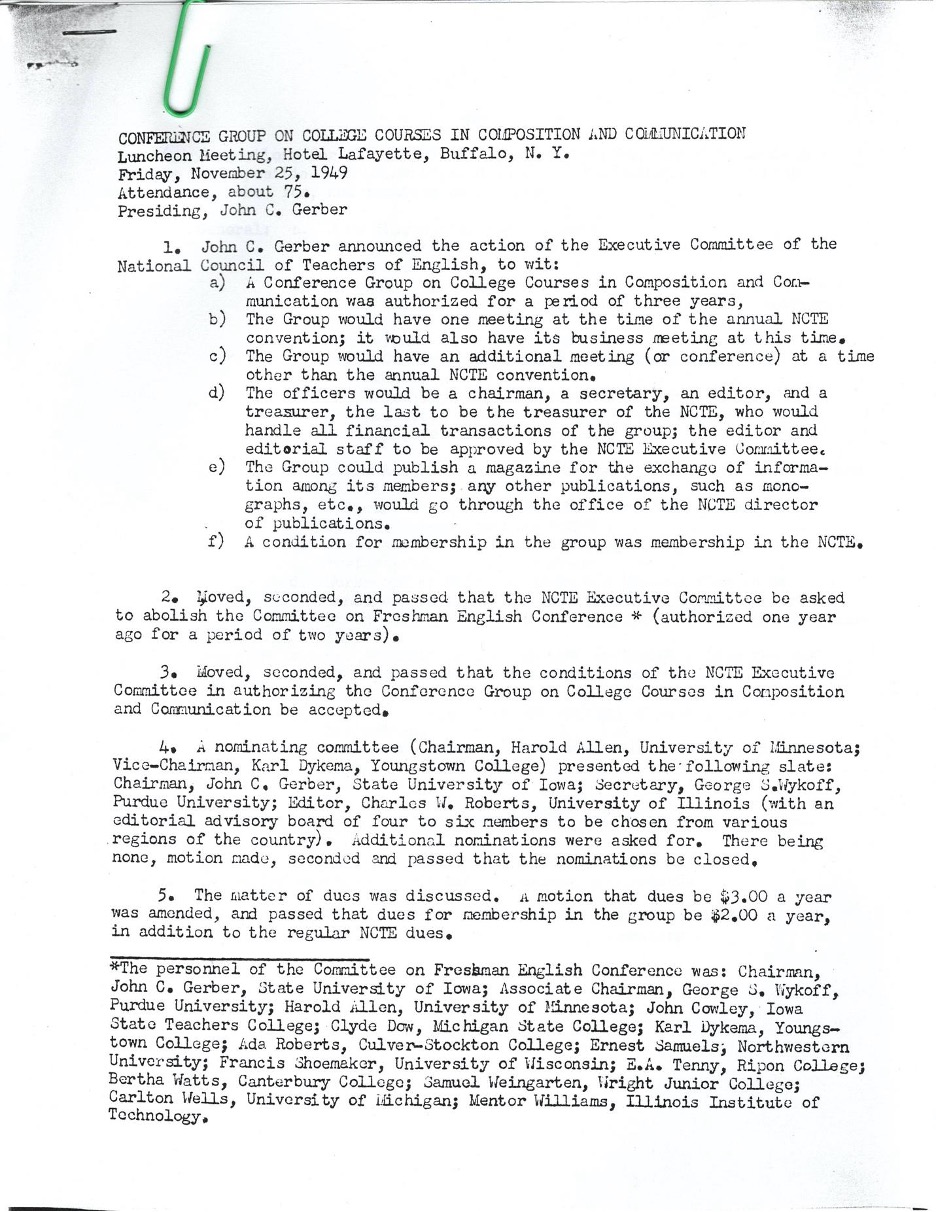
1949 CCCC Meeting Minutes
That lunch is more distant from 2024 than it was from the founding of CCCC in 1949. Kathi Yancey and I are roughly contemporaries, separated by four or five years, and as she noted in her interview, we were far from the founders of modern composition studies. But we knew many of them, and we knew the field when it was still finding its legs, with the first formal PhDs in rhet/comp starting only in the mid-70’s (at Iowa, which in the 1930 had granted the first PhDs in creative writing). My primary mentor after grad school was Jix Lloyd-Jones, co-author of the 1963 Research in Written Composition, signaled by many as a watershed volume in watershed year. 1963, after all, was when Ed Corbett’s “The Usefulness of Classical Rhetoric” famously helped propel an organizing principle for first year writing. My first C’s presentation (Detroit, 1983) was a response to Corbett, arranged by Rick Gebhardt, who Kathi notes brought peer review to the field’s flagship journal and who hired me to my first teaching position at then-tiny Findlay College.
You can worry where this is headed: old guy dropping lots of names in a fashion that might be interesting, might be pretentious, sure will be tiresome. But I’m situating a question essayistically rather than dialectically, about the nature of history in composition studies. Historicizing might focus on people, on ideas, or on events, and putting the brightest light on each shows something different—and with different effect—than casting that beam elsewhere. How does it matter whether the history is written in first person (the people, ideas, and events as I experienced them, the matter as it seems to me) or in third person (grounded in public records, the archive, things others have said)? The choice entails both an epistemology and a metaphysics, with implications for what claims it makes and work it performs.
Consider a few events in a ten-year span, each involving food, each part of my personal history in composition studies.
Summer 1994, Oxford, Mississippi, and I’m eating fried chicken at white tables on a mansion lawn. With me are Wendy Bishop, Lad Tobin, and Libby Rankin. We’re here for a conference jointly held by the Council of Writing Program Administrators (WPA) and the Association of Departments of English (ADE, the English chair’s subgroup of MLA). I’ve just started editing WPA: Writing Program Administration, and there’s some expectation from the ADE folks that I’ll put out a “proceedings” issue of the journal. I’m trying to figure out from my new friends how I might possibly make this work. I ultimately fail.
December 1999, Chicago, and I’m at the MLA convention. There’s a long tradition of WPA hosting a party for members attending MLA, and I’ve arranged to meet at the Billy Goat Tavern, made famous in an old Saturday Night Live skit with John Belushi. The organization can buy a cheeseburger (“no fries, chips”) and a drink for everyone. About 25 of us walk over from a WPA-sponsored session, and I have a long conversation with Jeanne Gunner about College English, which she’s just started editing, and about larger life matters.
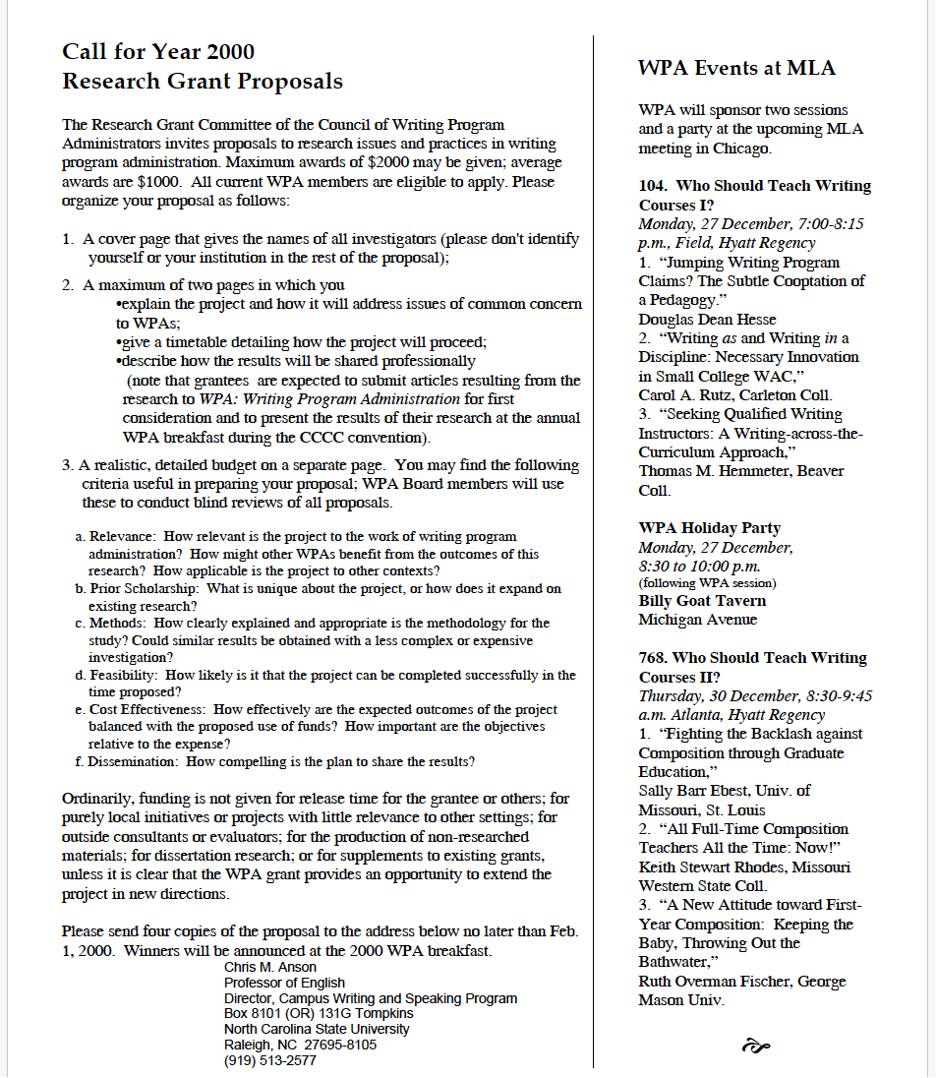
Call for grant proposals and list of WPA events at MLA, 1999
March 2004, San Antonio, a Thursday night, and I’m hosting a small dinner with Gunther Kress, Robert Scholes, Gail Hawisher, and David Laurence. I’ve invited Kress and Scholes, renowned figures in literacy studies, as featured speakers at the CCCC convention. They’ve never met, and I enjoy the mix of personal and intellectual repartee as they size up each other. Saturday night, after the convention has finished, the C’s officers and NCTE staff meet for a customary dinner to reflect on the past few days. I have everyone sign a menu.
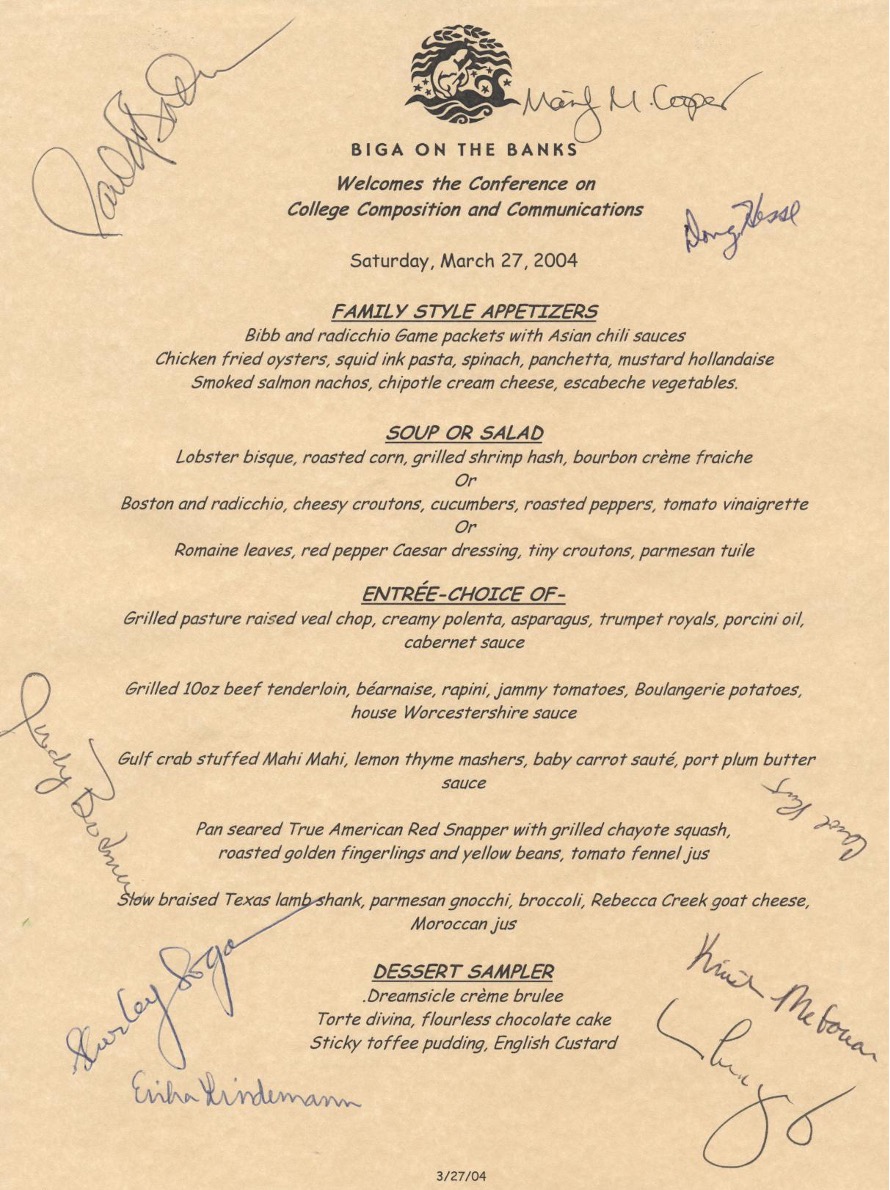
Signed menu from 2004 CCC event
October 2009, New York, and I’m at the fanciest dinner of my life presenting big checks to high school and college students who have won awards for creative nonfiction, in a contest I organized for NCTE. I talk with Toni Morrison, Ken Burns, Salmon Rushdie, Annie Lebovitz, on and on. Calvin Trillin introduces me, and I comment on what we learn about student lives from the thousands of their submissions. The event culminates the first National Day on Writing; Kathi Yancey had appointed me to the initial planning committee, and she and I did a livecast from a New York studio.
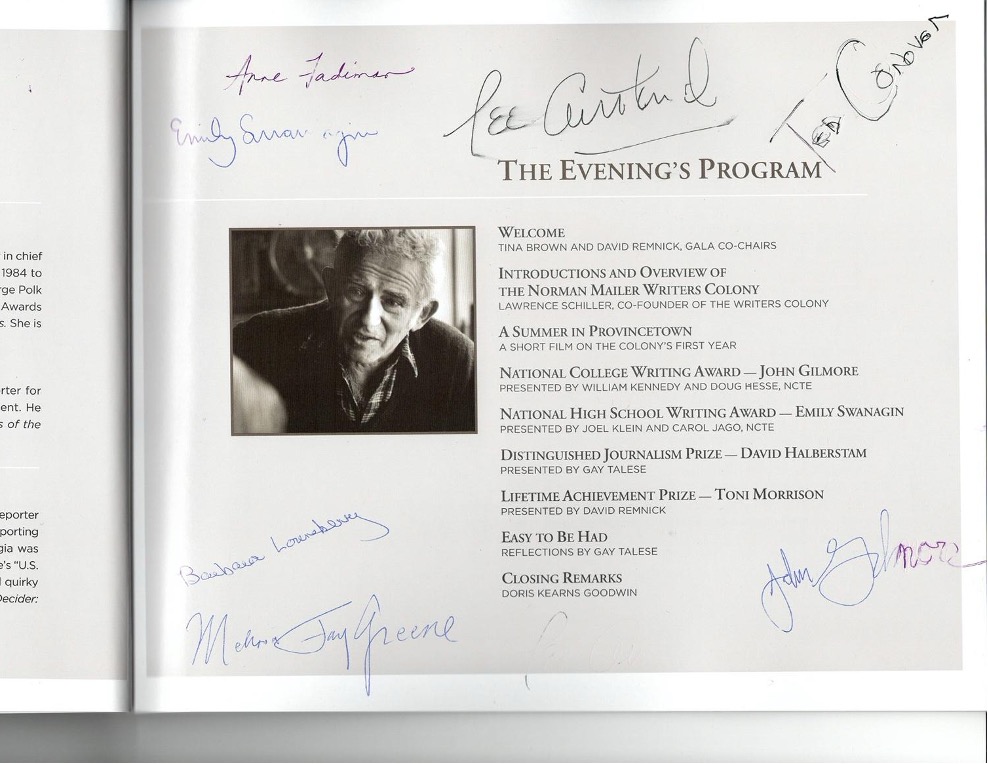
2009 New York dinner program
June 2023, Clemson, South Carolina, and the first five chairs of the fledgling Association for Writing Across the Curriculum, minus founder Michelle Cox, are having dinner on a patio beneath a tree. Thanks to the pandemic, this is the first time we’ve met in person. Mingled among conversations about summer vacations are ideas about AWAC’s past and future. Later, I join Kathi Yancey and Elaine Maimon, a founder of the WAC movement.
Is there history in these anecdotes? Certainly, they’re part of my professional life, mattering to me, but do they matter in some larger narrative, to the profession? On an important level, probably not—at least without being beaded into some larger narrative, enhanced by interpretation and implication: this event made this happen, with this consequence. I could tease out justifications, for example, talking about how picnicking with Wendy Bishop led in 2001 to her appointing me to form the CCCC Public Policy Committee. But even that wouldn’t necessarily be sufficient without going beyond “this happened” to “and it was significant because.” Contrast the snippets about my dinners with two different personal events I could have chosen. I chaired a session at the Portland WPA meeting in 1990, where the Portland Resolution was first conceived in a talk by Christine Hult. I participated in the 2004 CCCC officers meeting chaired by Kathi in Key West, which generated the Chairs’ Memorial Scholarship and the CCCC Research Initiative. Both examples led to policy. Without further scaffold, my earlier dinners are, at best, facts with potential to be historicized. Or not. In an undergraduate medieval literature class, my professor distinguished between annals, chronicles, and histories proper, the former being “mere” recordings of facts and events, the latter providing context and implication.
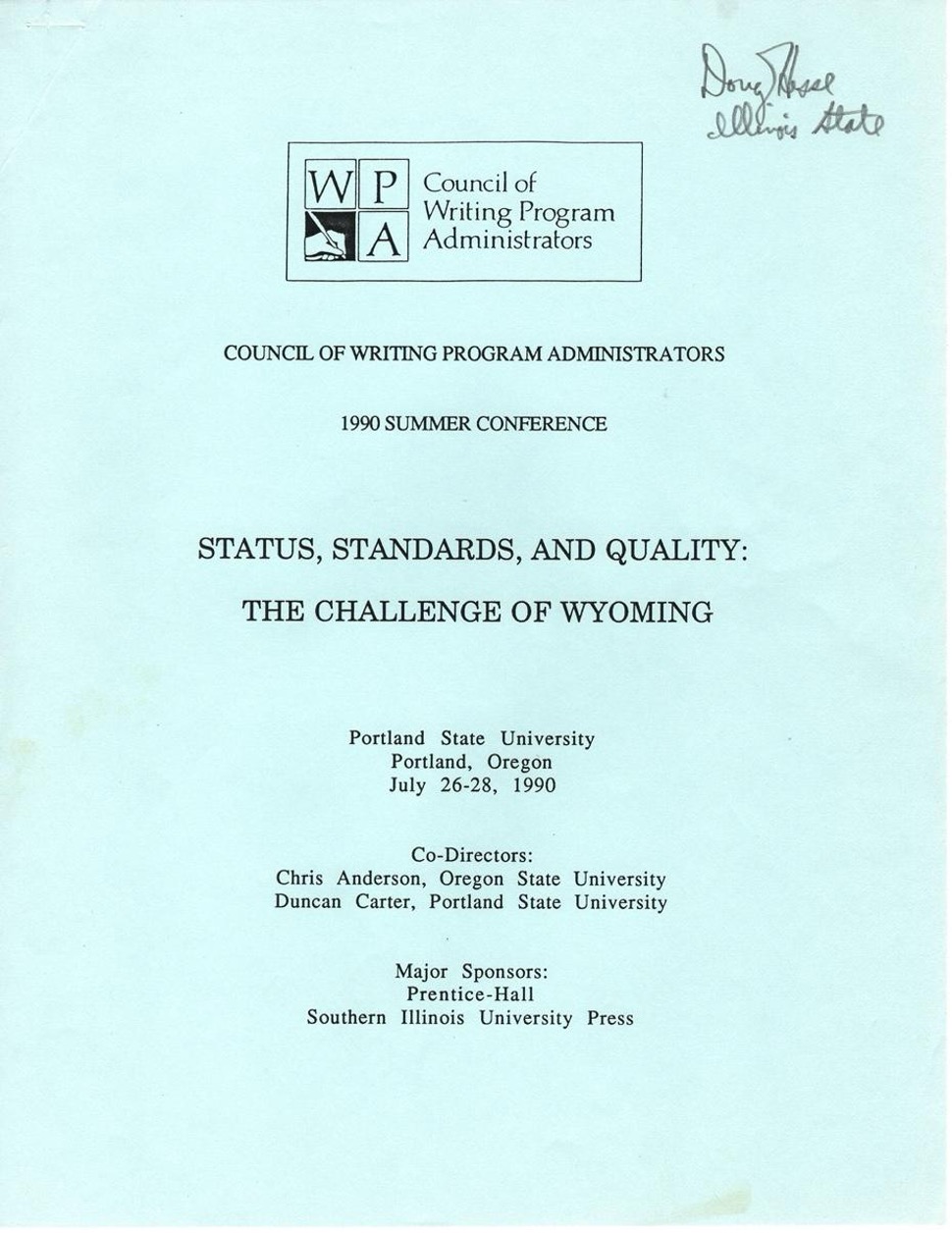
Council of Writing Program Administrators 1990 Summer Conference program cover
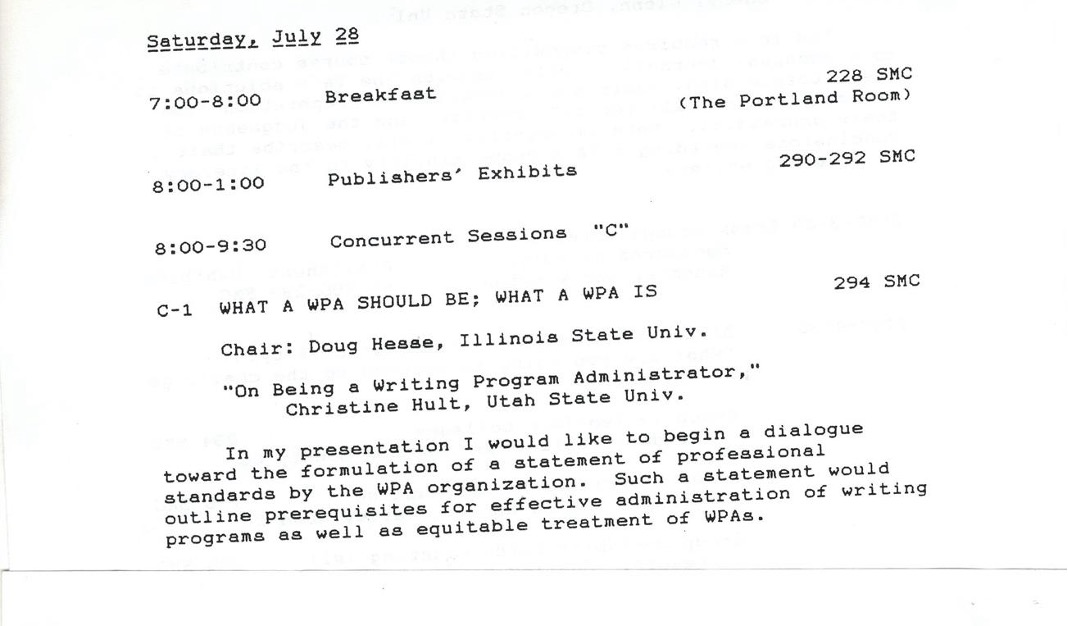
Abstract from Council of Writing Program Administrators 1990 Summer Conference
Given that tens of thousands of folks in composition studies over the decades can generate hundreds of thousands of anecdotes that are meaningful surely to each of us, the potential annals of our field are overwhelming. In Borges’ short fable, “On Rigor in Science,” cartographers aren’t satisfied until they produce a map of the scale 1:1, coinciding point by point with the land it depicts. The result proves too cumbersome to be useful. Still, it’s important to ponder the scale with which we might tell the history of composition studies. We’ve mainly settled on publications, and even among those, only a few become historical. All the rest of our professional pasts, the lived experiences of the field’s members are mostly absent—unless they get written. Even written, they’re considered memoir unless they connect personal experience to larger event or idea.
A thought experiment. Imagine that the several thousand current members of CCCC each write a personal history of their life in composition studies, each drawing parameters as they see fit: what they studied, what they taught, what they read, what they thought, where they went, who they knew, and so on. The result would be a Borgesian history/map of the field, perfect but so unwieldy as to be impractical. One could extend the thought experiment, imagining someone coding those thousands of personal histories to distill the most prominent themes and from them to produce a history. The coding scheme and its cutoffs would gain abstractive sweep at the cost of texture. The desire to be “objective” by, say, invoking frequency counts as the measure of significance would represent one ideology; what strikes the historian as “interesting” would be quite another. Choice and story.
I appreciate, then, Kathi’s response to her interviewer’s fair but impossible question about the most significant moments in composition history. Off the top of her head, she offers ideas with which I can hardly disagree: the founding of C’s, the subsequent founding of related organizations, from RSA to Computers and Composition, Bob Connors’ remarks at the first Watson Conference about what might constitute a discipline, Joe Harris’s 50th anniversary issue of CCC, Steve North’s The Making of Knowledge in Composition. With the luxury of more time, I nominate a few additions. (I’ll stick to Kathi’s time frame and thus omit essential landmarks such as Hugh Blair’s Lectures on Rhetoric and Belles Lettres, the late 19th century founding of first year composition at Harvard and its replication at colleges elsewhere, the 1930’s coordinated curriculum movement (a predecessor to WAC) and so on.) Thus constrained, I’ll nominate Research in Written Composition, bookended by George Hillocks’ 1986 Research on Written Composition; the 1966 Dartmouth Conference and its long tail in James Britton, et. al. The Development of Writing Abilities, 11-18; The 1978-80 NEH-Iowa Summer Institute; Shirley Brice Heath’s Ways with Words; The Elbow-Bartholomae Debate; the development of the Daedalus Writing System; the origins of portfolio thinking in the 1990s (especially Kathi’s own work); the London Group work on multimodality under Gunther Kress; Adler-Kassner and Wardle’s Naming What We Know. Obviously, once started, it’s hard to stop. (Jim Berlin? Janet Emig? Ed Corbett?) The enterprise risks replicating E.D. Hirsch’s Dictionary of Cultural Literacy, offering a check system to determine entrance to the composition parlor. (Hirsch’s The Philosophy of Composition, which Kathi mentioned, isn’t his only controversial contribution—and surely not his most personally lucrative.)
I’ve no space to elaborate my nominations. Each of these events/theories/practices/publications significantly inflected thinking and pedagogy in our field. Or at least I think they did, with some reason. You see, that’s part of my point. History is always history to someone, and that an event happened differs from that an event is worth knowing (and why) by lots of people, enough to stitch into disciplinary cloth.
Take North’s Making of Knowledge, chiseled into my comp studies Mount Rushmore. I still remember seeing its bright orange cover at the Boynton/Cook booth in crowded exhibit hall at CCCC, 1988, Atlanta. (It might surprise newcomers that publisher exhibits at C’s used to fill ballrooms.) North’s book so sensibly explained why the field perplexed me, laying out with clarity and wit the various scholarly traditions being poured into the composition punch. I assigned it in graduate courses, alongside Lauer and Asher’s Research Methods in Composition, and I assumed that everyone around the country surely did, too. No doubt citation analysis would confirm or dispel my attributing it landmark status. No doubt my view is partly inflected by coming to know Steve in the next forty years, including playing racquetball one Friday morning when he’d come to give a talk.
Personally transformative to me, and I suggest standing as another key moment in composition history, was David Schwalm’s creation of the Writing Program Administration Listserv, WPA-L, in 1993. For over a decade, this was the field’s coffeehouse and agora, where people gathered information, shared practices, announced job openings, debated ideas, recommended readings, recorded accomplishments, and so on. It’s hard to overstate the significance. Previously, information circulated at the staid speed of journals, newsletters, annual meetings, and billed long distance telephoning Now, information flowed at the speed of ethernet, in a plenitude that allowed casual conversations, the difference between film photography and digital. Significantly, there was a welcome leveling effect, as new assistant professors sought and shared advice with more experienced members, who in turn learned from newer colleagues and those in different conditions. While WPA-L focused early on writing program situations and practices, the list grew to broader topics in writing research and careers, performing a social role well before Facebook and Twitter. This mode of circulation fertilized new organizations, events, publications, and alliances. Of course, WPA-L happened in a larger digital atmosphere, but its effective on the field was transformative, its archival value unique, as demonstrated in Chen Chen’s careful analysis of listserv threads, 1993 to 2017. But even Chen acknowledges that the amount of information and complexity of the listserv architecture, leave vastly more work to be done. Some compositionists who came to know WPA-L only through reactions to a few cloddish or bad actors for some months in the late 2010’s have mis-essentialized the character and import of the list, the contributions of thousands of contributors in tens of thousands of messages in its existence. WPA-L was replaced by a more formal bulletin board; the informational/social media of the field is now much more scattered.
Rather than recounting additional historical moments, I’ll explore a bigger question. At one point in her interview, Kathi muses, roughly, “We don’t have a good sense of who we are,” and “We’d be better off if we had a sense of our own history.” But why?
The conventional rationale, after George Santayana, is to avoid repeating it. But when we consider composition-related things that keep being repeated or, worse, “discovered”—the five paragraph theme, the modes of discourse, explicitly teaching grammar “rules” and all the rest—it’s less that their advocates don’t know the history of these venerable topics, it’s rather that they don’t even know there’s a discipline that studies such things. Inside Higher Ed and The Chronicle of Higher Education are full of mostly well-intentioned pieces by outsiders ignorant of composition studies. Even scholars in field-adjacent major journals practice this unknowing. Writing in PMLA, in 2018, Angelica Bammer stated, “Writing is a form of analysis, a method of interpretation, and a mode of thinking. In this light, a critical inquiry into the state of writing in contemporary higher education is not just timely and relevant; it is overdue” (p. ). That the field’s members know history doesn’t confer herd immunity to uninformed outsiders, but it does help readily correct misinformation. Of course, knowing history means that pedagogy and scholarship can help the field develop more productively. That something has been researched, theorized, critiqued and found triumphant or wanting doesn’t mean it’s “over.” It just means any further work on the topic benefits from historical context. So do people consuming that work.
Having a sense of history fosters a degree of humility. It satisfies our egos to think that everything preceding the enlightened arrival of our cohort was flawed, that the rhetorical/intellectual/theoretical/political circumstances of the present render irrelevant knowledge and experience more than a few years old. It’s convenient to universalize scholars of a previous generation not only by gender and class but, worse, by attitudes and ideas. Keep in mind that the committee appointed to draft Students’ Rights to Their Own Language consisted initially of Ross Winterowd, Geneva Smitherman, and Jix Lloyd-Jones, who did the early writing (and final editing) before a group of Black scholars took it on. People now “discovering” the power of story and narrated experience would well recognize that scholars fifty years ago were making the case for students writing first-person narrative for reasons of identity and agency, not only of aesthetics. Autoethnography has its roots in memoir and the personal essay, genres historically inflected by their authors’ reading and events in the wider world. The tradition of essay, going back to Montaigne, differs quite a bit from the dismissive catch all term applied to all short nonfiction, especially formally rigid school papers. I understand that humility, along with the other six virtues, is culturally constructed, but in practical terms, it bolsters professional ethos. Folks might best avoid showing up to Burke’s parlor and fancy they brought the catering and hired the band.
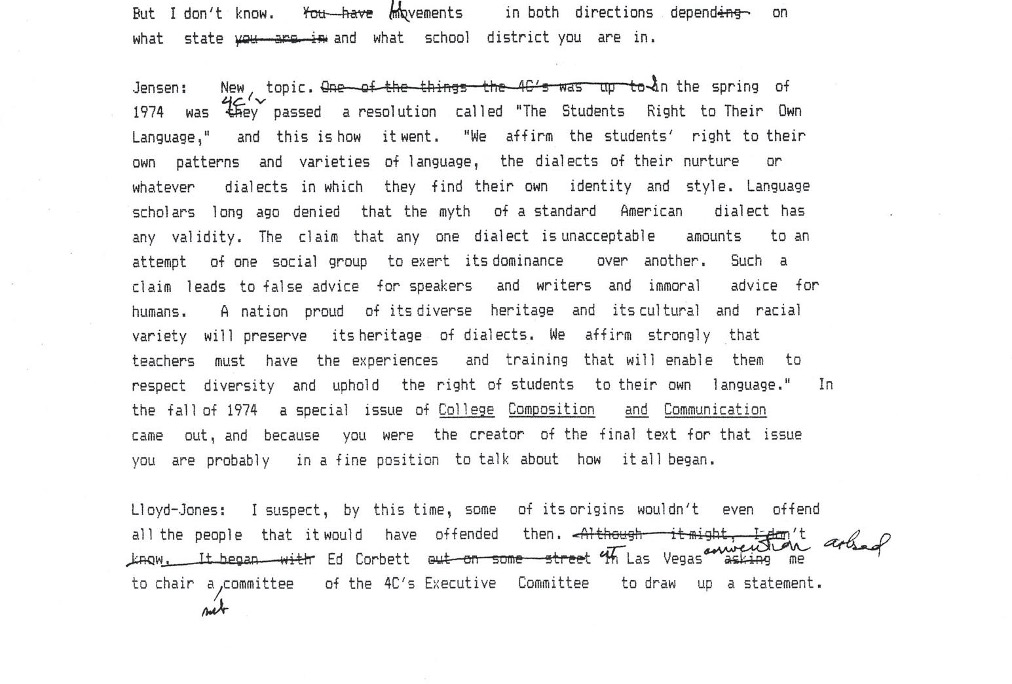
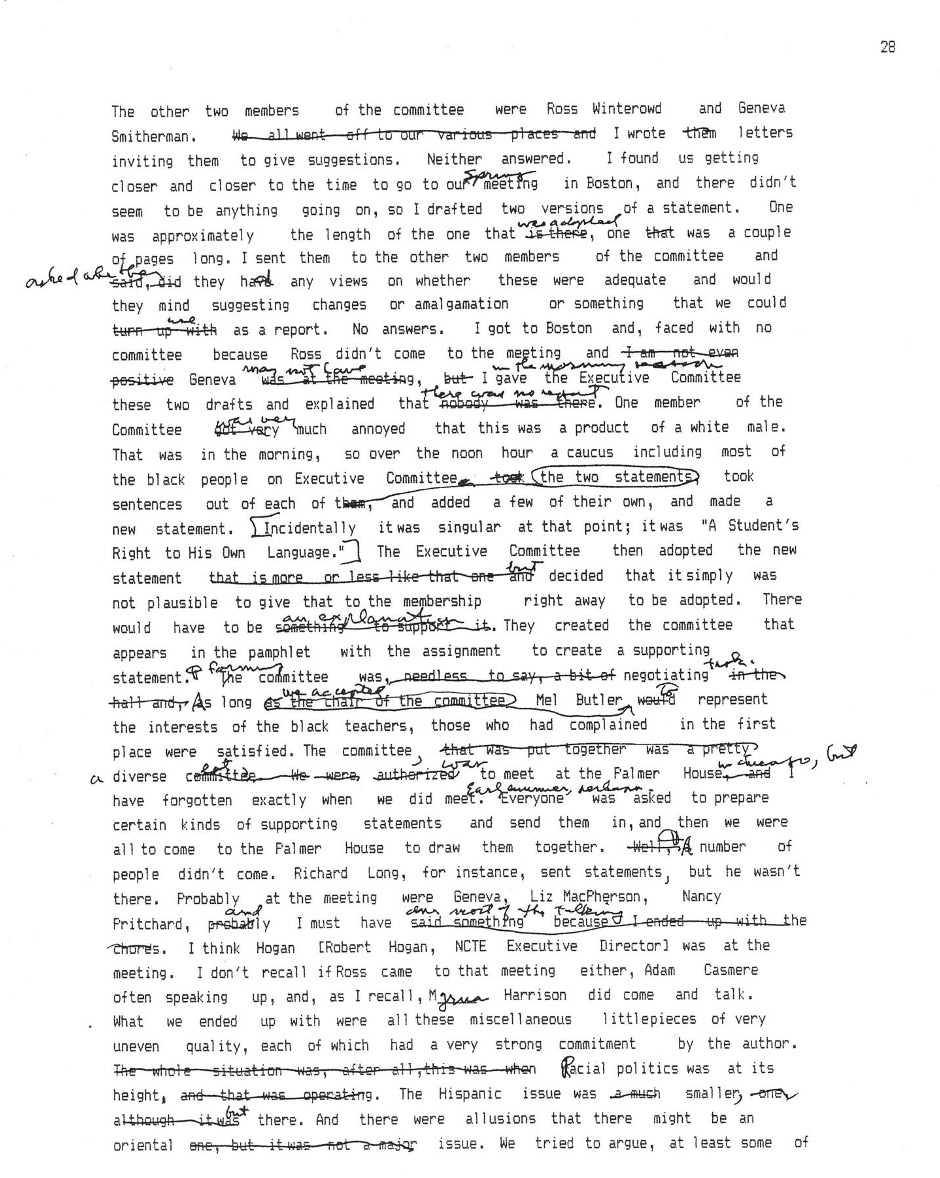
Excerpt from a lengthy interview of Jix Lloyd-Jones, by Julie Jensen, about the origins of Students Rights to Their Own Language
Knowing its history—even knowing that it HAS a history—benefits a disciplinary community’s efficiency, effect, purpose, and status. I’ve worried previously that disciplinary identity doesn’t count much lately in the modern university, where economic and market forces lead colleges to jettison majors as venerable as physics and math. Still, it’s better to function as a discipline (albeit not policing borders too zealously) than not. That members share a history, at least broadly, helps being taken seriously and accomplishing their work. One could cynically reduce that work to preserving reputation and jobs—at least for those members reasonably paid. But our field has civic, vocational, and personal responsibilities not simply to the vague end of “advancing the discipline” but more centrally to our students and the world in which we all live. Naïve, I know, but if we’re not about that, then we can find better pay elsewhere. We accomplish more ourselves, students, and civilization through efforts steeped in shared knowledge.
A final value, and perhaps most brow-raising: Knowing history fosters individual’s identities as members of a tradition, not alone but connected, drawing support and significance by being part of something larger. I know this must sound hollow to the person teach six courses a term at three different schools, and I know my own experiences as a 5/5 adjunct 44 years ago offer them no consolation. Stories of the distant Olympians dining with each other might inspire people, but they might just as easily madden them. We need then a history not only of Titans but of people doing the work in relation to one another and to the field. Both/and. And it’s not just a matter of knowing history but participating in drafting of it—including perhaps through the thought experiment I offered a few paragraphs ago. In Kenneth Burke’s terms, our goal might be consubstantiation with composition studies through the people in it. This happens through ideas, certainly, knowing the shaping concepts and their lineage, knowing where my own practices fit, in something bigger than myself. But it also happens through people and the incidentals of life along the way. It happens through inscribing, not only consuming. Both/and. It’s instructive that popular science writing, collected in annual series like The Best American Science and Nature writing, almost inevitably relies on narrative profiles of scientists beyond their science, on visits to labs or observatories or field stations; a description of scientists’ physical features and mannerisms; parties and conversations. David Kaiser’s book Quantum Legacies, for example, is replete with bits like “Jason and Andy mused that night over burgers: Could we somehow exploit these large-scale features of the universe to test quantum theory” (59)?
Perhaps we writing teachers might take a lesson from scientists and write additional kinds of histories, ones that have us engaging with others, together on our way to making ideas and policies and curricula and energies, at picnics, in taverns, at dinners in ballrooms or beneath trees, maybe with founders, maybe with friends. We might write about a sunny patio in Bellingham, Washington, overlooking Puget Sound in July 1994, where I first talked at length with Kathleen Blake Yancey.
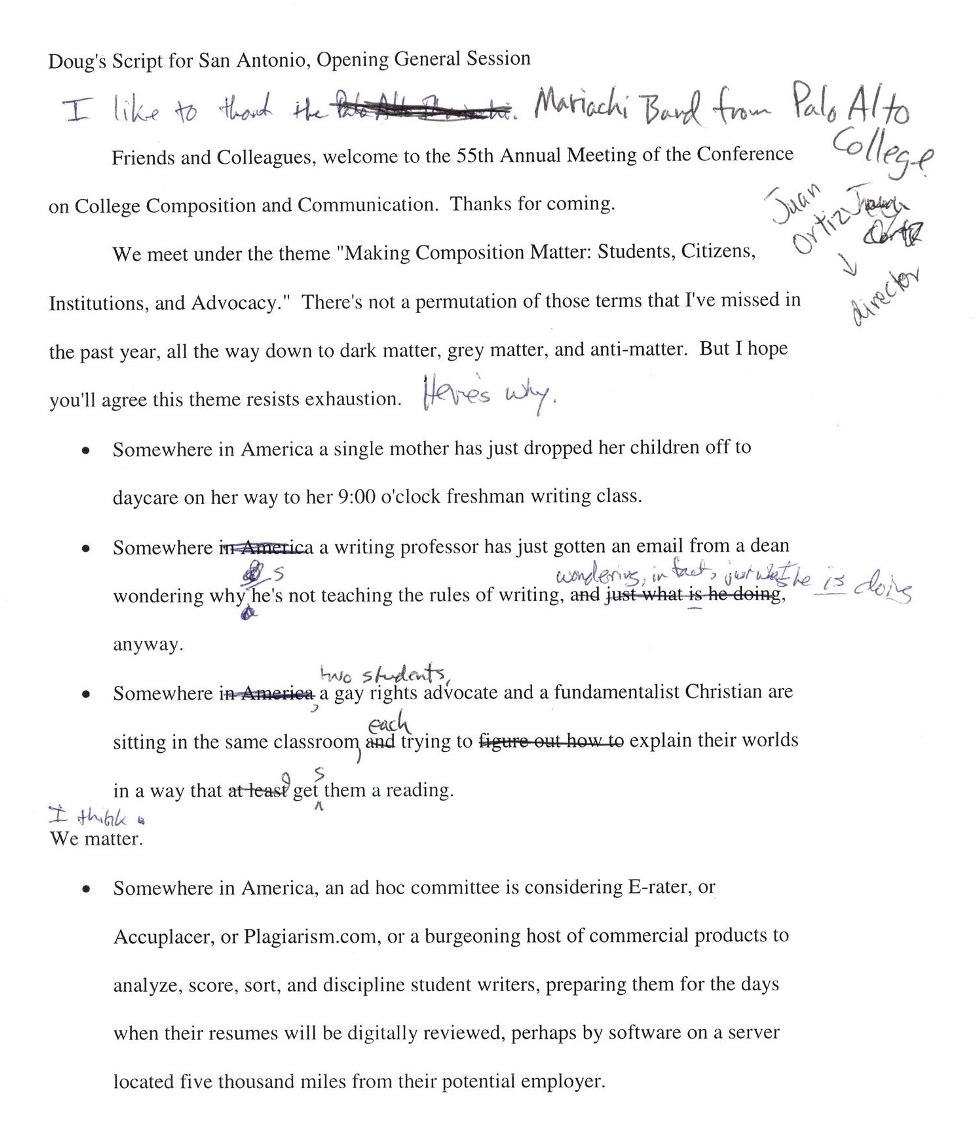
Doug's opening script for the San Antonio CCCC General Session
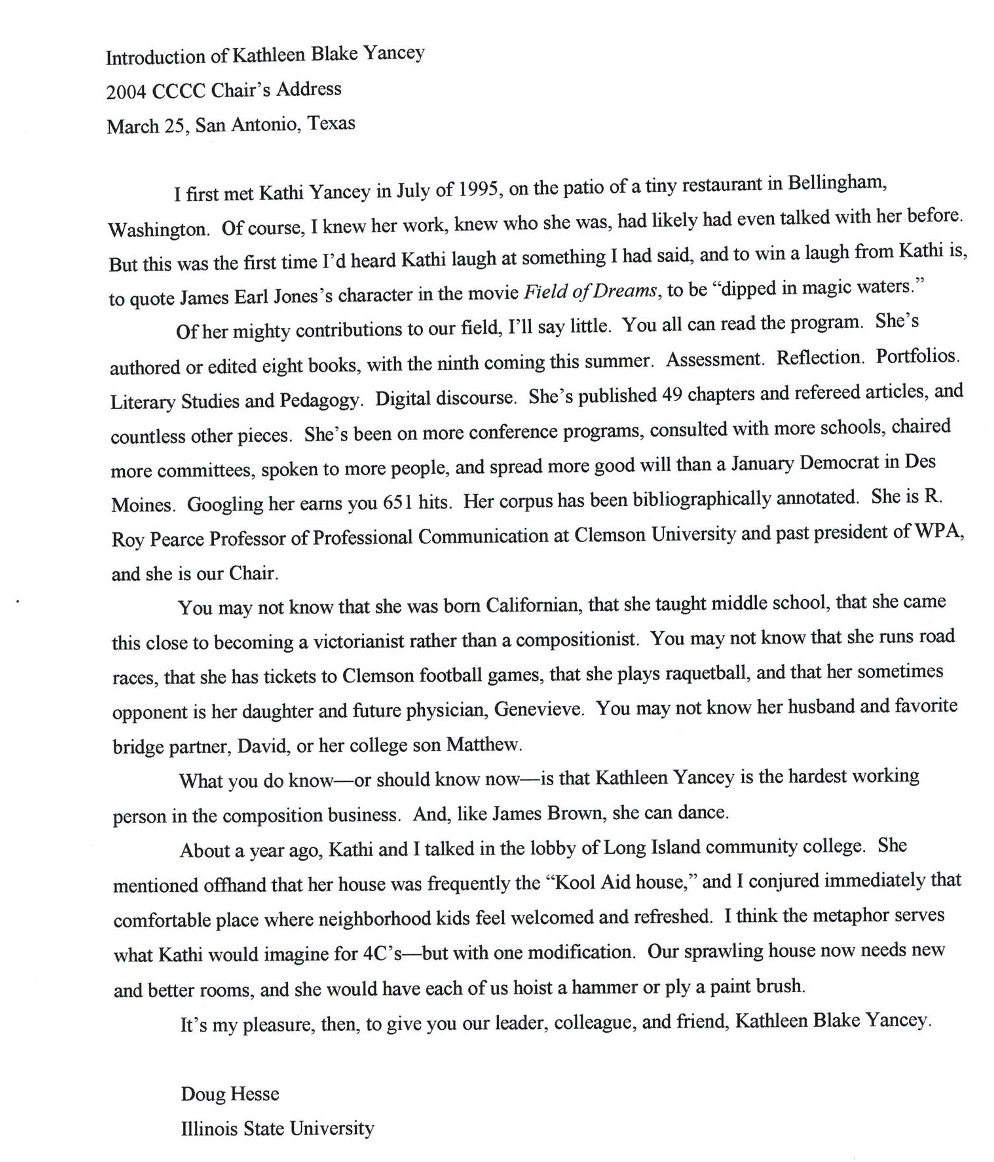
Doug's introduction for Kathi's 2004 CCCC Address
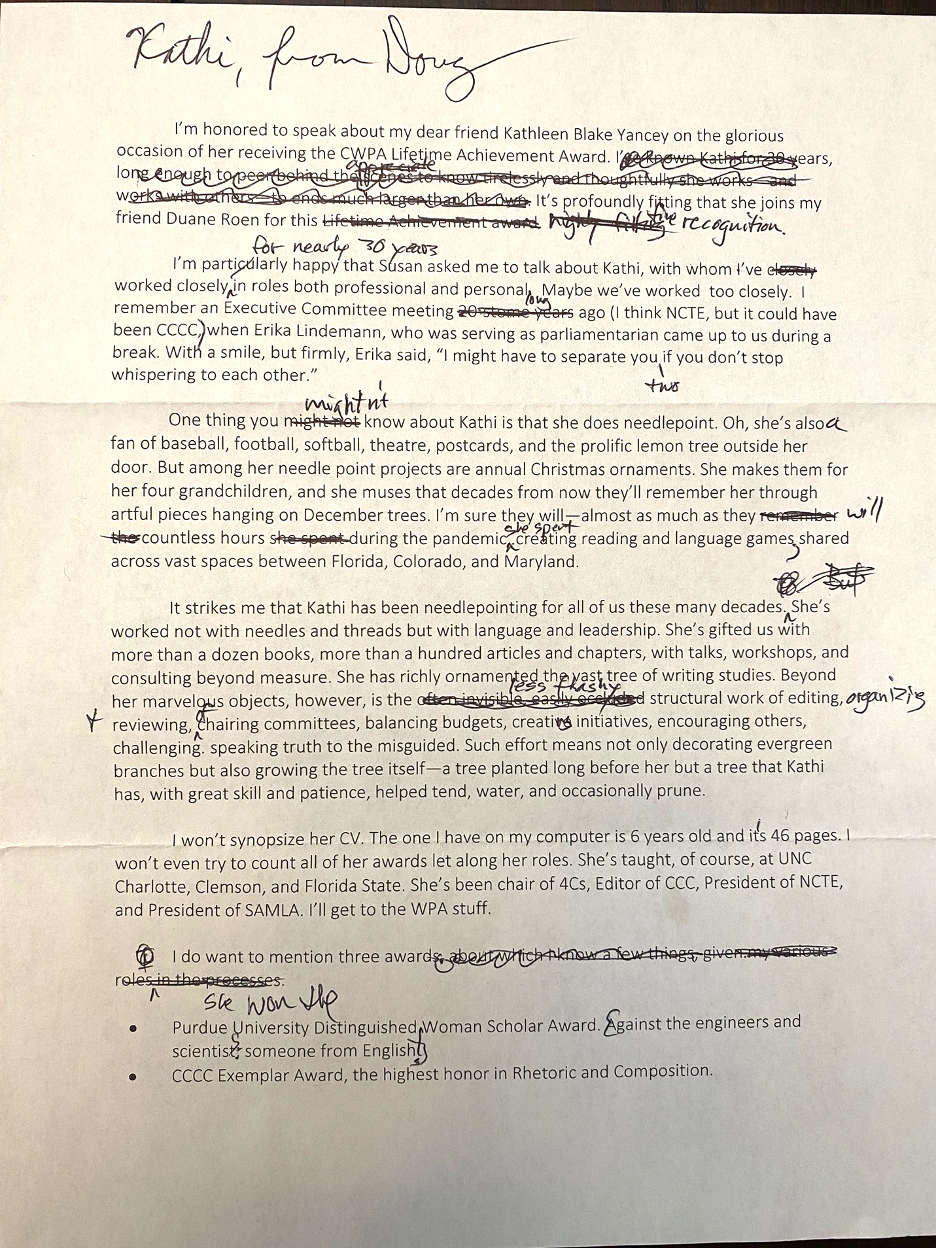
Doug's edited remarks on Kathi's reception of the CWPA Lifetime Achievement Award
Adler-Kassner, Linda., & Wardle, Elizabeth. (2015). Naming what we know: Threshold concepts of writing studies. Utah State University Press.
Bammer, Angelica. (2018). Introduction to how we write now. PMLA, 131(1), 124–131.
Borges, Jorge Luis. (1964). On rigor in science. In Dreamtigers. University of Texas Press.
Braddock, Richard, Lloyd-Jones, Richard, & Schoer, Lowell. (1963). Research in written composition. National Council of Teachers of English.
Chen, Chen. (2021). From 1993 to 2017: Exploring “a giant cache of (disciplinary) lore” on WPA-L. In A. Licastro & B. M. Miller (Eds.), Composition and big data (pp. 138–158). University of Pittsburgh Press.
Heath, Shirley Brice. (1983). Ways with words: Language, life, and work in communities and classrooms. Cambridge University Press.
Hesse, Douglas. (2023). Creative nonfiction accents the National Day on Writing. In Doug Hesse & Laura Julier (Eds.), Nonfiction, the teaching of writing, and the influence of Richard Lloyd-Jones (pp. 157–174). WAC Clearinghouse; University Press of Colorado.
Hesse, Douglas. (2018). Redefining disciplinarity in the current context of higher education. In S. Miller-Cochran, R. Malenczyk, E. Wardle, & K. B. Yancey (Eds.), Composition, rhetoric, and disciplinarity (pp. 287–302). Utah State University Press.
Hillocks, George. (1986). Research on written composition. National Council of Teachers of English.
Kaiser, David. (2020). Quantum legacies: Dispatches from an uncertain world. University of Chicago Press.
Lauer, Janice M., & Asher, J. William. (1988). Composition research: Empirical designs. Oxford University Press.
North, Stephen M. (1987). The making of knowledge in composition: Portrait of an emerging field. Boynton/Cook.