



Kathi Yancey comments on how variable, situationally specific, and contested the term originality is in the academic world, even though contribution and novelty are core to the motivational and reward systems of all disciplines. She notes, further, that the term originality has particular currency in the humanities, which prize the unique qualities of a person’s thoughts, feelings, and products. Composition in the US, arising within the humanities, maintains that high valuation of originality, with self-expression and discovery central parts of current pedagogy. She notes, however, that this high value of originality in writing becomes hemmed in during graduate schools and academic careers by disciplinary expectations.
Although the teaching of writing in countries outside the US has varied disciplinary histories with different pedagogical consequences, writing in most places serves for students to develop, practice, and be assessed for knowledge and thought in most subjects at all educational levels. Consequently, originality in school writing takes on a specific meaning as the antonym of plagiarism or cheating by substituting someone else’s work for one’s own. However, in educational practice originality or plagiarism is a more subtle and complex matter than is generally recognized. If the school assigned writing task is, for example, to write a comparison of some assigned readings, the assigned readings are not original to the student. Nor are the comparative methods the students would use. The comparative analysis would, however, be expected to have its origin in the student work, even though the answer and indeed the total text may contain no news for the teacher or assessor beyond the student’s ability to carry out the task. If the student had to photocopy the readings or other assignment handouts from a fellow student because of an absence, that would not be plagiarism. However, copying the comparative analysis from that same fellow student would be plagiarism, cheating, and unoriginal.
In another example, if the student were asked to discuss the sociological and cultural history of his or her family to be gathered by interviews with relatives, the student might appropriately derive theory and even models for organizing the text from other sources. The student could even discuss those sources with classmates inside or outside of class. The student, however, would be expected as an individual to conduct the appropriate interviews with relatives, and collect, record, and analyze information from those interviews. Using interviews done by classmates or published elsewhere about people who were not family members would make the work unoriginal and unacceptable, no matter how much fresh text and analysis the student did to come to new conclusions. If the student wanted to use material from published interviews conducted by others about his or her eminent relatives, the student would need to disclose that, explain why using that published material was relevant and useful, and obtain the instructor’s approval. In short, expected originality is quite specific to expectations of the work to be done by the student, even though expectations may be explicitly negotiated.
Until European university reforms began in the late eighteenth century, universities were far more interested in enculturating the young with received knowledge than advancing new knowledge or developing fresh student thought (Bazerman & Rogers, 2008). The development of new knowledge, insofar as it occurred, happened elsewhere in society. Nor was creative individuality or personal expression much valued in writing until the European romantic movement, also starting in the late eighteenth century (Woodmansee, 1992). Nor until the same time had the idea of national genius expressed in the unique thought, character, and products of a nation emerged, thereby appropriating individual originality into the collective (Andersen, 1991). Nor did the legal regime of copyright and intellectual property which assigned economic value to originality of printed texts and patent filings become established until that same period (Rose, 1993). Indeed, the word originality does not appear in English until the latter half of the eighteenth century, according to the OED (1971). Earlier medieval uses of the term original referred only to whether a document was the source document and not a copy, or something was the beginning of a continuing condition or process, as in “original sin.”
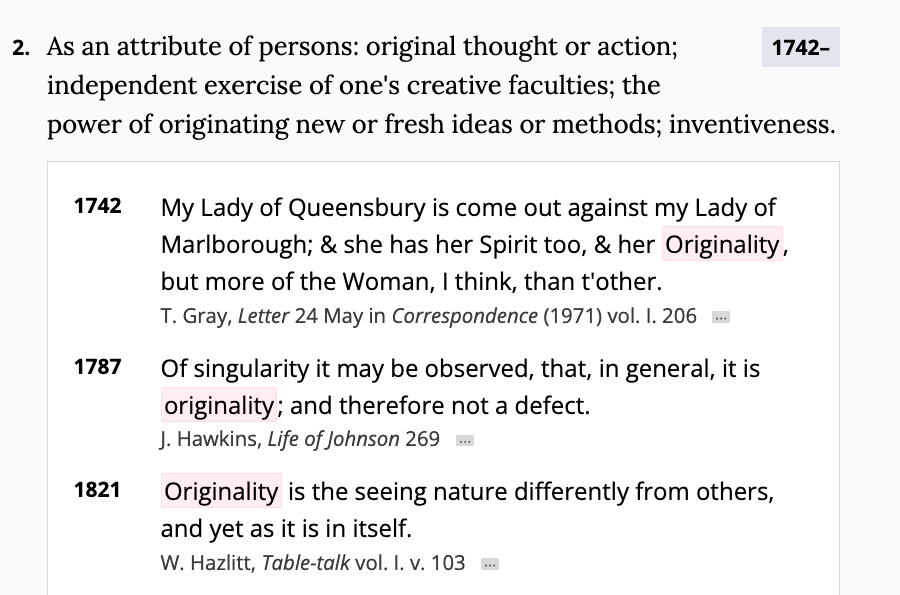
Figure 1. Screenshot of OED entry for "originality"
This is not to say that the modern uses of the term originality aren’t useful or valuable, but only that the term and the associated concepts are recent inventions and variable in what they mean, how they are applied, and what the consequences are. Despite abuses, the system of intellectual property with the protection of its economic value for limited periods seems to be a useful innovation. Similarly citing intellectual accomplishment within disciplines (Bazerman, 1991) has helped make knowledge production a more collaborative, communal enterprise and make knowledge production more coherent and cumulative. It has also motivated individuals to make contributions because of the multiple benefits that come with publication, citation, or even eponymy (Merton, 1968). Even (or especially) leisure reading requires some surprise and novelty to provide pleasure, engagement, and even wisdom (according to the expectation of the genres writers present their work in and readers locate it in). Without an expectation of some uniqueness in leisure reading, libraries would be small and book sellers would need few offerings.
We learn our language and its various means of inscription within the sea of words from others around us. As Bakhtin notes, to have expressive means, to be intelligible to others, and to accomplish our own purposes, we must use shared words, inhabiting them with our own intentions (Bakhtin, 1982, p. 294). Kathi notes that we live in the Bakhtinian sea of words, but she finds that common heritage in tension with originality, and points to the “anxiety of influence” popularized by Harold Bloom’s 1973 book of that title. Bloom, however, locates that anxiety within romantic poetic ideology which creates an expectation of the poet being the origin of genius and values works on their originality. The Bakhtinian recognition that we inhabit others’ words with our own intentions relieves the anxiety that one oughtn’t to be relying on what has been written by others, although the writer may face many challenges in realizing his or her intentions through writing. This is just how language and writing work, with individuals caught in the difficult middle of composing their own messages out of the common language.
Every genre, or communicative utterance, is accompanied by expectations of particularity, situational appropriacy, and intentional meaning making. These expectations guide the utterer or writer in forming a communication and the receiver in making meaning, evaluating, and acting on or responding to the communication (Bazerman, 2010). The language producer must do some local, particular, value-added work, to make every utterance meaningful, even if only using words produced by others and repeated many times. A parent chooses a particular bedtime book to read aloud, perhaps even insisted upon by their particular child, in order to make that particular bedtime moment emotionally rich and comforting. The expectations of parent and child enter into the making of the moment even though the words, word by word, were scripted by others.
The same parent as a writer may fill out a loan form to purchase a house in which to happily share bedtime rituals with the child for years to come. That form will likely include a legal name (confirmed from a legal document), accurate current and previous addresses, information about financial condition, earnings, employers, and so on. The applicant may be selective or strategic, though not fraudulent, in what is included and excluded. The applicant may even have the opportunity to add a crafted statement about responsibility for repayment or other relevant information. The reader who evaluates the loan application expects all this information would match other documents, including credit agency reports—which the parent, by the way, may have carefully curated over years by monitoring loans and fulfilling commitments. If any requested information is left blank or is inaccurate or somehow deficient, the loan application may fail. The adult’s intentions to obtain a loan and the bank’s intentions to secure a long-term asset will likewise fail, and no loan contract will ensue. This simple-seeming document requires much value-added, situation-specific work expected to be done by the applicant.
Of course, other kinds of writing may require much more overtly novel work by the writer who seeks the approval, interest, or engagement of the reader; the reader will also expect this work to be done at the risk of disappointment, disengagement, or disapproval. In each case, however, the work must somehow either meet the reader’s expectation of a particular kind of novelty, situational relevancy, or value-added work done by the writer—or the writer must successfully enlist the reader into some kind of changed, expanded, or redirected expectation which the reader will see the work fulfilling. This is true whether a simple piece of merchandise is being ordered from a website or the most elite creative work is submitted to be published and marketed.
This meeting of value-added expectations is also required of disciplinary publication, which is one of Kathi’s touchstones in considering the term originality. Disciplinary publication requires some disciplinary knowledge news, even if it is of a replication of an earlier contribution by someone else, adding confidence to the earlier finding. Successful communication of that news requires intertextual awareness of prior and related contributions of the field to establish the news value, and requires the researcher to have carried out the work according to disciplinary standards and procedures, modeled and discussed in prior publications. Thus, much value-added work has to be done and represented in the publication for it to carry its news. If the writer offers an innovation in conflict with any of what is expected, the writer must successfully argue for the innovation—and that argument itself must be carried out within the expected reasoning, evidence, and goals of the field. The greater the innovation, the more work must be done to expand the reviewers’ and readers’ disciplinary expectations. Otherwise, it will not be published within a disciplinary forum, which authenticates that the text meets disciplinary expectations as a potential contribution. Any attempt to bypass disciplinary publication by appealing to a different field or finding extra-disciplinary presence has even higher argumentative burdens to gain ultimate disciplinary visibility and value.
Figure 2. September 2012 cover of CCCC OED entry for "originality"
So the disciplinary writer’s work is to convince the reviewers and readers that their desires for advance of disciplinary knowledge will be met, even though it might require a detour, an expansion of expectations, or redefinition of disciplinary knowledge. The reviewers and readers of a paleontographic journal, for example, may expect the report of some newly discovered bones and other remains with perhaps a description of a newly discovered species. If the research team, however, intends to reconfigure an evolutionary line of descent, along with a changed understanding of the capacities of early hominids the authors may want to draw on sociological, anthropological, and archeological theory and techniques, along perhaps with some neuroscience. So the novelty is not only in the bones and the theory and methods being drawn on, but the synthesis of these elements to create a new kind of account. While the journal reviewers and readers might be well satisfied with a description and immediate implications of the data, how far the journal is ready to accept the authors’ notion of contribution may be a matter for contentious negotiation, to be fought out in reviewing processes. (For detailed examination of two cases of negotiation of what counts as an acceptable disciplinary contribution, see Myers, 1985).
In all kinds of writing, inside and outside academia, at stake is the expectation of value-added work, how the author goes about accomplishing it, and how the readers go about accepting and valuing it. Sometimes the situation, task, and generic expectations are obvious and unproblematic, but sometimes the challenges of matching authorial intentions and readers’ expectations are more difficult. The term originality is just one way of labeling that expected value-added work within some documents within certain socio-cultural systems, with the caveat that those socio-cultural systems and the accompanying expectations continually evolve, moved by the actions and arguments of the participants over time.
From this perspective of expected value-added work, our first task as teachers is to help students recognize the specific value-added work expected of them and the existing resources available and/or needed for each task. Identifying just these two things will go far in demystifying the often vague expectations of originality. Our next task is to provide students with guidance on how they can accomplish both kinds of work—of locating and deploying the resources they need and accomplishing the expected value-added tasks. The resources can be everything from expected formats and terminology to available prior evidence and theories. The value-added work may then mark the uniqueness of their responses as fresh thinking, fresh experience, or just local situational specifics. Drawing on less expected resources can provide new material to work with (perhaps from other readings or disciplines), new ideas or models or methods, personal material, or long-standing interests and evolving understandings. But as teachers of writing, we should also help students recognize the added burden unexpected novelties bring and help students develop strategies for stretching expectations to make their messages meaningful, persuasive, and valuable within the genre and activity system they are participating in (for a detailed study of the work involved in introducing novelty, see Bazerman, 1999). Novelty, innovation, or originality is not an absolute good—it must become visible, meaningful, and valuable in the realms in which it is being communicated, or it will readily be dismissed as nonsense, non-meaningful, useless, of no value, not worthy of attention, and ultimately non-communicative for the audience.
So I am now ready to return to the quotation for which Kathi identifies me as the originary source:
I end with a paradox: the more one attunes to communal existence and the resources communally developed, the more focus and resources one can bring to a task so as not to view the task in a conventional way and not to be limited to the most conventional tools. Deeply immersed in the situation and attuned to a wide selection of the potential resources developed over human history, one can perform work that appears more original across more circumstances, finding fresh possibilities within the particulars of circumstances than the person who prizes difference and stands apart. (Bazerman, 2010, pp. 468-9)
The quotation continues with a pedagogic implication:
It is this paradox that makes plagiarism paranoia so harmful. Plagiarism paranoia puts barriers between us (teachers, writers, students) and as much of the human experience and accomplishment as our path through life allows. Only by drawing deeply from the collective resources can we add most fully to them and pay our share of the rent. (p. 469)
While we want to give students the communicative means and confidence to solve new problems that address the conditions and needs of their lives, those means include the riches offered us by others from which we create anew. In helping them realize their intentions we ought not frighten our students from reaching deeply into the social world of knowledge by insisting on impossible versions of originality. Yet we can also help students think through how they can attend to and expand readers’ expectations to appreciate the novelties and work-added they bring to their communications—which will redound to their originality.
Anderson, B. R. (1991). Imagined communities: Reflections on the origin and spread of nationalism. London: Verso.
Bakhtin, M. M. (1982). The dialogic imagination. Austin: University of Texas Press.
C. Bazerman (1991). How natural philosophers can cooperate: The rhetorical technology of coordinated research in Joseph Priestley's History and Present State of Electricity. In C. Bazerman & J. Paradis (Eds.), Textual dynamics of the professions (pp. 13-44). Madison: University of Wisconsin Press.
C. Bazerman (1999). The languages of Edison’s light. Cambridge MA: MIT Press.
C. Bazerman (2010). Paying the rent: Languaging particularity and novelty. Revista Brasileira de Lingüistica Applicada, 10, 2, 459-469.
C. Bazerman & P. Rogers (2008). Writing and secular knowledge within modern European institutions. In C. Bazerman (Ed.), Handbook of research on writing: History, society, school, individual, text (pp. 157-176). New York: Routledge.
Bloom, H. (1973). The anxiety of influence. New York: Oxford University Press.
Merton, R. K. (1968). The Matthew effect in science. Science 159: 3810, 56-63
Myers, G. (1985). Texts as knowledge claims: The social construction of two biologists’ articles. Social Studies of Science 15, 4, 593-630.
Rose, M. (1993). Authors and owners: The invention of copyright. Harvard University Press.
Oxford English Dictionary (1971). Oxford English dictionary (Compact edition). Oxford University Press.
Woodmansee, M. (1992). On the author effect: Recovering collectivity. Case Legal Studies Research Paper No. 1992, 10 Cardozo Arts & Ent. L.J. 279.