



The basic premise of Bruno Latour’s approach to networks is that everything is a network. The way to understand this premise (i.e., how is X a network) is to trace out the connections and disconnections in a given moment, place, event, failure, body of work, belief, success, legal issue, romance, and so on. Through this tracing and through the descriptions of this tracing, one will better understand the presence of networks around us and among us; the invisible – what we did not perceive as a network – will be made visible. Latour’s concept declares that networks encompass daily life, but we are not always aware of their presence or shaping of belief, practice, ideology, writing, the everyday, and other activities. “Network is a concept,” Latour writes in a quasi-contradictory manner, “Not a thing out there. It is a tool to help describe something, not what is being described” (Reassembling the Social 131). Thus, the task, at times, is not to identify how a social media platform is a network or how a body of scholarship is a network or how academia is a network (though they are networks), but rather to describe and make visible the ways actors encounter one another within a given space, body, or moment and how these encounters may or may not produce meaning. As a tool, networks assist in understanding the variety of ways meaning comes into being.
Kathleen Blake Yancey, in a video interview discussing networks, states, “there are some network relationships that are entirely unhealthy if not toxic.” Yancey’s network allusion is to the Republican party and its support for Donald Trump. Using network as a tool, one could trace and describe the Republican party’s policies, politicians, voters, past policies, iterations, various presidents, and more recently the Donald Trump presidency. In turn, like Yancey, one might identify a tracing of toxicity by identifying tropes associated with contentious discourse or dysfunction. Both Trump presidencies offer a legitimate space to explore toxic networks – his rotating cabinets or abysmal choices for his cabinets, his Supreme Court nominations, his foreign policy, his misogyny, his racist statements. Such an exploration might shed light on the types of actors who connect in ways to spread an object called “The Republican Party” across elections, broadcasts, social media, conversations, video interviews, and elsewhere. Instead of following Yancey’s questioning of a toxic network politics, however, I want to explore toxic networks elsewhere. I am less interested in Republican toxicity than in toxicity itself as a network, or as an approach toward further understanding of social media based discursive spaces. Latour’s promise of description, it seems to me, neither romanticizes nor dismisses networks as healthy or unhealthy. I won’t even claim that toxic networks – despite the presence of the word “toxic” in this description – are unhealthy. My usage of “toxic,” as well, does not refer to the toxicity of environmental disaster, work place moments, or related events, but rather to the affective state of relations and interactions across networked spaces typically associated with human relationships, whether they be conceptual or digital. Toxicity, as it is commonly understood, serves in specific network spaces as discourse itself.
What do we mean by “toxic?” Often, when discussing the digital, we mean social media. Social media has often been described as polarizing or as an echo chamber where users repeat what they already believe or engage in conflict. Some social media apps generate more attention than others for bad behavior. “Twitter tops the list of most toxic apps,” a Forbes headlines reads (Suciu). “Why is Twitter so toxic?” a Reddit subthread asks. Twitter, a network of hundreds of millions of users sending short messages to the platform (now known as X), often serves as a digital toxic example for popular media reporting. “It is the Twitter of our discontent,” James Wolcott writes. “Every season is the Twitter of our discontent. Spring, summer, autumn, winter—doesn’t matter. Its revolving eye of Sauron never blinks.” As one New York Times writer adds:
Twitter is a living nightmare. It’s overly simplistic, and too prone to flattened discourse and protracted, useless fights. It’s full of in-jokes and cliques and factions and a small number of people who are too loud and too rude. It’s messy as hell with glaring problems that don’t have a whole lot of good fixes. Sounds a lot like real life. (Warzel)
In this brief tracing of Twitter discussions (minus actual usage), we see a network of described toxicity localized within one social media platform because, we assume, of the ways users interact on the platform. Bad interactions (yelling, criticizing, demeaning speech, racism, anti-Semitism, misogyny, homophobia, generic fights) supposedly generate a toxic network based on the observations and tracings various readers of these interactions make. The actors within a social media networked called Twitter include people writing, the writings, the platform itself, the retweet, the like. Whether or not the platform is innately toxic is difficult to determine because it needs these actors to be something we call Twitter or X. Without these various actors, the platform may still be toxic or it may be something else. Twitter is, in addition to possibly being toxic, banal and quotidian. Users tweet daily. Indeed, social media, based largely on daily moments and posts, is banal overall. I am mostly interested in the daily, banal toxic interactions that occur on social media, and, in particular, in specific Facebook groups. Twitter is not the only networked platform to be described as toxic; Facebook, too, earns this distinction from the popular press. “Facebook is a harmful presence in our lives,” The Guardian declares (Sadowski). “Mark Zuckerberg can’t wash away Facebook’s toxic image,” Vanity Fair announces. “Facebook’s algorithm promoted toxic and hateful content,” the Daily Mail notes (Duell). Following these concerns, I ask if Facebook, as well, provides a toxic network worth studying, and if one specific Facebook group focused on dating can serve that purpose. While these critical headline assessments assume that either social media platform is “toxic” in a negative sense (the platforms encourage and support bad behavior), I focus instead on the discourse itself, a discourse that must be toxic for users to understand each other and share meaning with each other. I understand that the difference may be difficult to understand at first, so I ask for patience while I trace out this network.
What do I mean by toxicity? There exist numerous definitions of toxicity – from masculine toxicity to romantic issues of devaluing or discarding. For this short piece, I am more interested in how a specific toxicity exists as a social media form of discourse among an ambiguous network of actors and interactions occurring digitally. I will call this digital space the romantic sphere. In particular, romantic networks spread out within social media spaces where the description “toxicity” is both discourse and also identified as central to topics being discussed and shared. Within these networks, we might encounter actors whose interactions help create these networks. These actors include supposedly toxic phrases such as “red flag,” “ghosting," “gaslighting,” “love bombing,” or even the term “toxic” itself. Other actors include Facebook groups, Instagram posts, digital forums, advice columns, the writers, assumptions, and more. For my purposes, I want to trace the romantic sphere’s banality of toxicity online. My rationale and homage to Yancey’s scholarship stems from the coincidental usage of the term “toxic.” Toxic, as a complicated, layered term, embodies much of the romantic-based interactions in social media spaces such as Facebook.
“An ‘interaction,’” Latour writes, “is a site so nicely framed by localizers behaving as intermediaries that it can be viewed, without too much trouble, as ‘taking place locally’” (Reassembling 202), One function of the network is behavior. Everyday behavior is banal. Everyday online behavior can be just as banal. In. 2020, after I divorced, I began reading the daily conversations in various Facebook groups devoted to divorce, single dads, dating, and related topics. While my initial intent may have been therapeutic – searching for a support group – my interest quickly changed into a pseudo-ethnographic examination of what people discussed and how these networks supported and possibly diminished toxicity. In romantic relationships, narcissism, jealousy, infidelity, and selfishness can be considered toxic traits. These traits, in turn, become moments or place holders for expression in Facebook interactions and conversations, as I will eventually trace to some extent.
I am not aware of Kathleen Yancey writing about toxic, romantic relationships in her scholarship. I am aware of the networked nature of some of her writings. In her CCCC address, “Made Not Only in Words: Composition in a New Key,” Yancey notes that sometimes we have moments. Moments, we might generalize, encompass some form of activity – perceived as important or not – which shapes and influences other moments. Moments can be grand, but I assume they can be banal and quotidian as well.
These moments: they aren't all alike, nor are they equal. And how we value them is in part a function of how we understand them, how we connect them to other moments, how we anticipate the moments to come. (297)
Digital interactions, too, are such moments. I partly take inspiration from Yancey’s address in my network exploration. I also partly take inspiration from her published pieces with Michael Spooner. These pre-social media essays, written as collaborative conversations, reflect the ways moments network with other moments, often as conversations or their imagining of digital conversations pre-Facebook. In 1996, reflecting on the then “novel” ways email might generate networked interactions, they write about moments affecting moments as being an issue of voice.
I don't think we have an argument much, even though we do have more than a single point of view. But we write in different voices, and this is a problem if one insists on proper genres. Can’t we just call it a text? (254)
I call various Facebook groups exchanges, too, a “text” in the sense that the text they contribute to and are a part of is not one group but many groups voicing and conversing over similar issues: divorce, being single at 50, dating at 50 or older, meeting new people, being rejected, being unable to date, being promiscuous, being celibate, and so on because these are topics networking romantic toxicity. In addition to Yancey’s comment on networks and toxicity, my choices also stem from Yancey and Spooner’s example of love exchange.
If you have been in love, if your lover could write, you know what I mean: it appears every day. It’s transactive-not plain exposition, not pure narrative. It’s a letter, but then, not the sort of letter you get from the bank or university. It’s more like a conversation. It’s not conversation: it’s one-way, and it’s written And it’s written in the knowledge that days may pass between the writing and the reading – that in fact (though heaven forbid) it may be lost before it reaches you. As you read it, it speaks in the familiar voice of news, disappointments, and desires. It’s affectionate – full of affect. (“Postings” 258)
Yet, on social media, such “love letters” are written as conversations among affinity groups who share similar disappointments in romance or what they have come to believe are toxic relationships. Indeed, what I have viewed to date reflects not a concern with being toxic, but a toxic network itself caught in actors’ voices. The group networks I have considered are Dating Over 50 Discussion Group, Over 50. . . Single & Ready to Mingle, Life After Divorce, and Separation, Divorce and Relationships. Conversations in these Facebook groups tend to revolve around requests for advice, updates on one’s love life, reporting back on a date, critiques of dates, gender stereotypes, declarations of not dating, critiques of dating apps or dating profiles, critiques of each other, and critiques of dates’ behaviors. These conversations are affectionate – full of affect. That affect generates, though, not an affectionate network but rather a toxic network. For purposes of space, I’ll look quickly at one of these Facebook groups.
Consider the following posts from the Dating Over 50 Discussion Group. This Facebook group provides a digital affinity space for a specific age group seeking relationships, mostly after divorce but some after a spouse’s passing or a major break-up. Unlike a dating app (such as Bumble or Hinge), members are not attempting to date each other in the discussions and are actively discouraged from doing so by the group’s guidelines (though members may be doing so privately). Instead, members create moments to connect to other moments by posting various events, activities, concerns, jokes, and disappointments. These moments interact with moments members may not know (moments outside of the group where a date occurs), but also moments members relate to (past experience influencing current beliefs about romance) or moments that members read their understanding of relationships through (cliches, experience, previously held beliefs). These posts circulate moments within moments: break ups, perceived slights, ghosting, sexual advances seen as too early, failed first dates, anger over someone not splitting a dinner bill, anger at someone for taking leftovers home, calling an app a “dumpster fire,” and so on.
Most members post under their names, but some also post as anonymous. I do not have the space to offer a networked tracing of all correspondences I understand acting with one another as a toxic network. I can, however, provide a small glimpse into the toxic networks that provide a platform for such interactions. The interactions – like the Yancey/Spooner love conversation metaphor – are affective glimpses into spaces of hurt, suspicion, lack of confidence, anxiety, apathy, despair, and other emotions often labeled as part of toxic networks. I pose them here as a list and crowded narrative of posts. In screen shots and citations, I remove names and in cited posts, I do not name the poster for purposes of preserving privacy, but also because, in this case, the individual names are not important. These posts are in public membership spaces. They shed some initial light on toxic networks spread out over a group within a popular platform. I read them not for particular content (not picking up a bill on a first date is a red flag), but for their overall networking affect, what I call a romantic sphere discourse functioning almost entirely off of toxic exchanges. That is, the exchange cannot function or provide meaning without these types of posts the way any other exchange (medical, sports, retail, food) cannot function without its specific discursive gestures.
A few posts from October 26, 2023 showcase ambiguity but also a nervousness and lack of confidence in the dating process. These posts, I contend, reveal a sustained network of negativity and toxicity, yet, these affective states do not prevent further contributions or push the membership elsewhere. The opposite occurs as members mostly remain and continue building the network through other connected toxic exchanges of anxiety, doubt, remorse, anger, and similar affective states. Comments, which I cannot replicate here, carry on the toxicity as a discourse to be followed. But posts, as well, networked with one another. The following posts are from 2023.
“Do you believe in unconditional love in a relationship ?” one post asks. Another asks, “What’s A Word OR Phrase The OPPOSITE SEX Uses That YOU ADORE⁉️😍” And another poses the following:
“DATING. In your 50’s...ugh. It’s like trying to rent out an apartment where a murder took place...everyone is spooked! LOL! We all have our own pasts and a certain amount of own baggage, but I’m not looking for ‘easy’... just not SO HARD. How are you single ladies handling it?”
A post from October 31 queries dating apps and discussions, many of which often go nowhere or are deleted quickly by a user without explanation:
This question is more for the ladies. After matching on Bumble and you make the first contact. How many times do you keep asking questions after the guy responds with zero questions? This interview method does NOT work for me. Seriously do I have to ask, “any questions for me?” Just a sign of poor communication skills.
A post from November 6, notes infidelity.
So I somehow got totally burned by a gentleman I was dating. Saying he loved me, wanted a future with me etc. The whole time he was seeing another woman, and telling her the same thing. And I knew something was off, but kept making excuses.. So now I am over it and back dating, but how on earth are people ever able to trust another person after that. I feel like a fool. Totally snowed by him...
Some post headings from Dating Over 50 represent toxicity: Don’t Judge a Woman by Pounds and You Won’t Be Judged By Inches, Nobody’s Nicer Than a Guy Who Hasn’t Slept With You Yet, Marked Safed From Being on Any Dating Apps Today, Heal, So You Can See That Attention is Not Love, Attachment is Not Connection, and Bare Minimum is Not Effort.
A post from August 25 reads: “Do these married/have SO men think that never being available on the weekends and only wanting to text us Monday through Friday 9 to 5 or after 11 PM is going to fool us? Just stop already.” Another reads: ““I am very specific in my Match profile that if you are not willing to at least “walk” a 5k (3 miles) with me that we are not a Match. Paul says he read my profile and that we have a lot in common yet he missed that part. He has never done a 5k but feels that his stint as the quarter back on his JUNIOR HIGH football team is equal to that. Why do ppl think what they did as a teenager is pertinent now?” A post from September 8 reads: Before you text him first, just remember.. there’s a girl that don’t have to.” A post from December 17, 2024 reads: “Guys have you ever gone on a date and all she talks about is what needs to fixed with her house or cars? Ladies we have feelings, we not just here to be your handyman.” A post from December 10, 2024 reads: “I need some advice. I'm seeing a great guy. I've known him for a few years but we just recently made it official. Problem he smells weird.”
Some screenshots from October also network these moments.
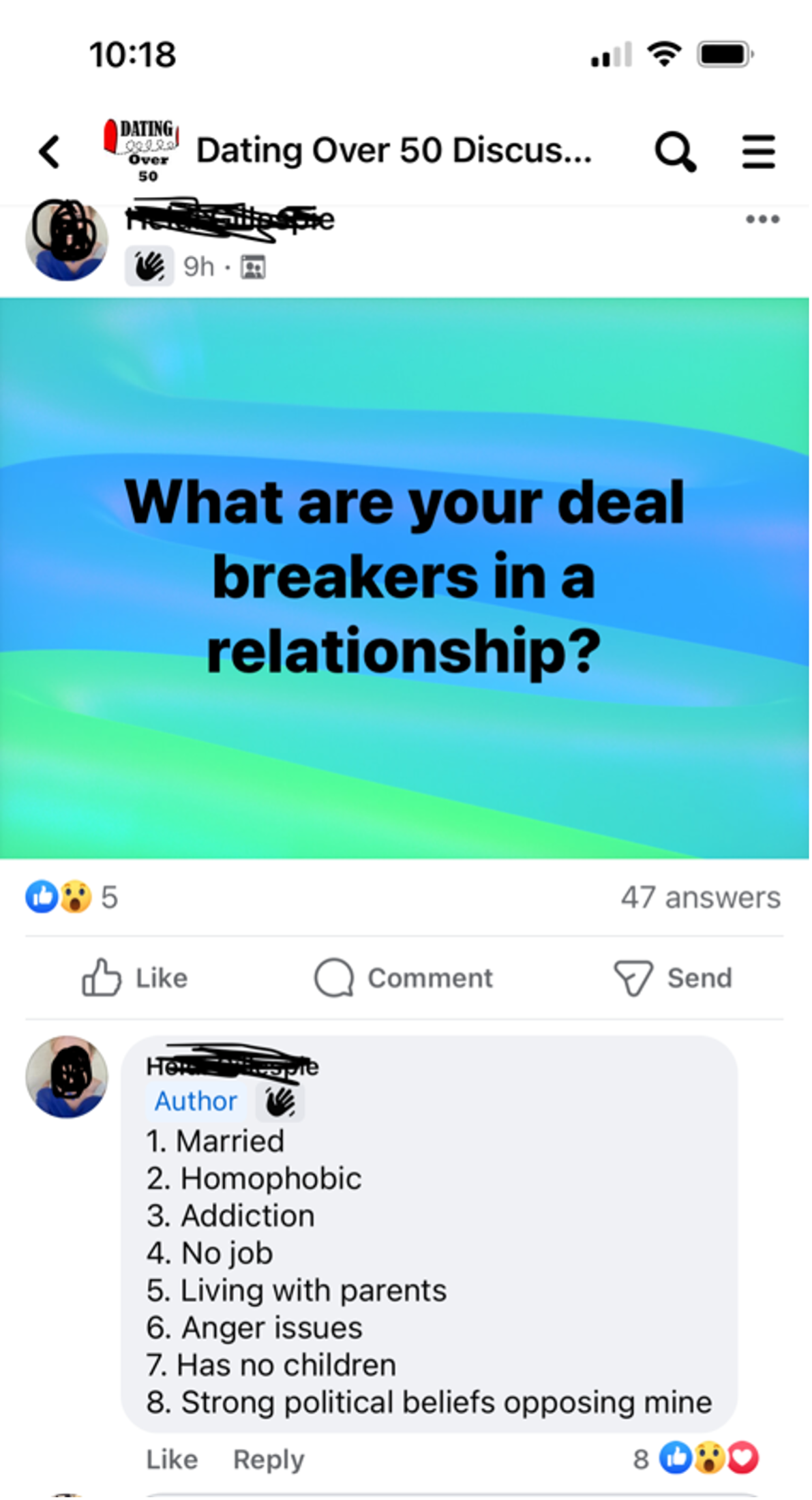
Screenshot of FB post: What are your dealbreakers?
![Screenshot of FB post: I don't know why men friend request me. Why would woman just add men as a friend that the don't or that they don't know 1 thing about ? I just message them back and say , I receved your friend request , but I don't add people I don't know in person May I ask why you reached out and where you came across my profile. I figure If they really want to get to know me they can message me and we can talk ane meet in person if we so desire to get to know each other better. You do't have any right to know antrhing about me or my family and friends if you can't have a conversation with me or meet me in person I'm not sure how a lot of you use your fb , but in is for my family and friends. If you are interested in getting to know someone just reach out via messenger [all errors sic]](images/2.png)
Screenshot of FB post: I don't know why men friend request me...
![Screenshot of FB post: Hello, advice needed. I was in an exlusive relationship with a man for 2 years and reently found out that he was also in an exclusive relationship with another woman for 4 years. I confronted him and immediately ended it and then I found the other woman's infor and contacted her and told her about his cheating and provided her the proof. She definitely was not aware that he was seeing both us and she was so devestated. So I went to my doctor to get a full STD screening and found out that I ahve an STD! This hurts more than the breakup! I was married for 27 years and have been divorced for 4 years and I had a full STD screening done after my divorece which was all clear, and this is the first man I have been with since my divorce. So I know I got it from him. SHould I reach out and tell the other woman? And him too?? Never thought I'd be in a situation like this as this stage of life... [eyeroll emoji]](images/3.png)
Screenshot of FB post: Hello, advice needed...
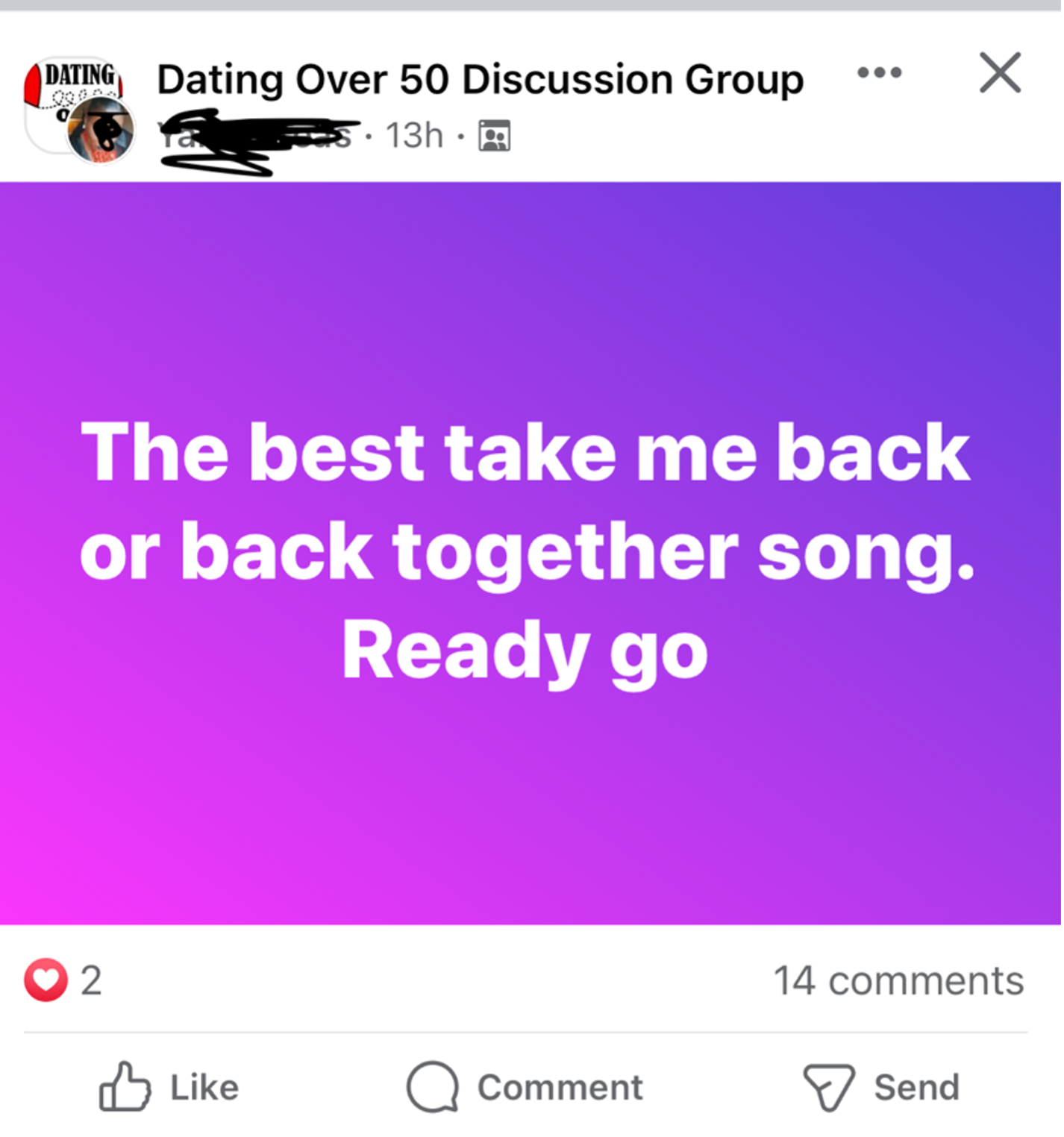
Screenshot of FB post: The best take me back or back together song. Ready go
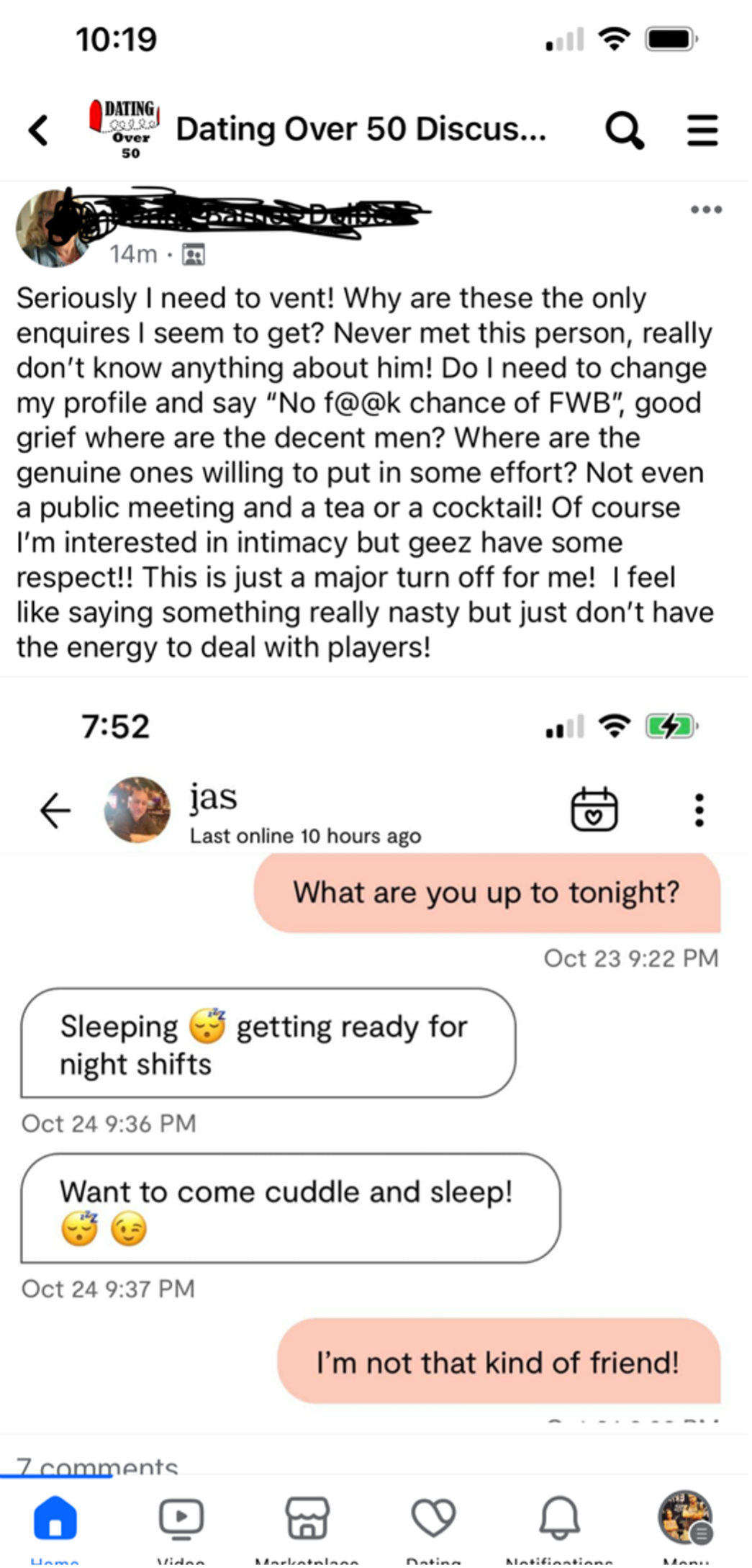
Screenshot of FB post: Seriousl I need to vent!
In these moments, we witness several exchanges that build off of and interact with one another as they generate a larger, often angry, suspicious, resentful, or hurtful, networked conversation. We see an interlinked exchange of anxiety (afraid of a potential friends with benefits situation, betrayed relationships, deal breakers, breakup songs). Within the posts, as well, are hundreds of comments, many of which extend or add to the post’s position within the network. The comments question, critique, and wonder why anyone would date the original poster, offer their personal experience, shame a poster for sleeping with someone early on or going to a man’s house on the first or second date, call out the negative posts as unnecessary, re-enforce the need for such negative posts, blame the original poster for whatever problem he/she experienced, and much more. In these moments, there exists a toxic network. This network exists only because of the toxic exchanges. It does not function on positivity or “hang in there” or “it gets better” or any other circulated cliché often targeted at individuals in the romantic sphere. This network functions because of toxicity as a discourse.
Why is such a network important to identify? What have I gained by isolating various Facebook messages and reading them as a “text?” Does this toxicity speak somewhat to the nature of digital communication? Is such a network pertinent to Yancey’s interest in networks within some of her scholarship? Regarding digital writing, Yancey and Spooner argue for “another kind of essay”
a text that accommodates narrative and exposition and pattern, all three. It allows for differentiation without exclusion, such that it resists becoming unified in a community of shared final ends (“Petal” 91)
I do not claim that a toxic network on Facebook is an essay. I note, however, that an overall narrative, one which I have traced out slightly, exists. Exposition exists. Patterns exist. Arguments exist. Narrative exists. What these patterns tell me is that toxicity is a broader conversation that cannot be situated in one space or moment but within a larger series of interactions. We can suspend our need for qualitative evaluation (this is bad/this is good) and instead adopt the Latourian tracing as an unveiling of a particular rhetorical phenomenon.
Toxicity, in some digital spheres, functions as a type of digital communication. Unlike a toxic relationship or situation one wants out of or to fix, the toxic network of the romantic sphere is expected by its human actors to remain as is because the toxicity allows them their “voices.” That individuals continue to participate in these spaces and contribute to them in similar ways suggests that the toxic romantic network, despite the anxiety and hurt feelings shared over time or specific moments or among each other, offers its affinity members something worthwhile and with meaning. This network offers a communal space of interaction and of moments. Thus, group members continue to build the network with their experiences, impressions, and observations. What the network teaches me about social media and digital moments is the lack of finality to these narratives, their continuation throughout the network as actors appear, disappear, and reappear to help shape and bring into being meaning. That meaning, as I understand it, is toxic. In this brief network description, I shift attention away from Yancey’s concern with toxic as representative of unhealthy networks (which, of course, do exist) and focus instead on toxic as network. The toxic network in question is healthy in that its toxicity allows for the commons its participants desire to participate within. Without this toxicity, the participants in this Facebook group do not have the means to engage with the discussions they wish to share. In her NCTE report “Writing in the 21st Century,” Yancey makes the following observation about networks and Facebook:
In fact, in looking at all this composing, we might say that one of the biggest changes is the role of audience: writers are everywhere, yes, but so too are audiences, especially in social networking sites like Facebook, which, according to the New York Times, provides a commons for people, not unlike the commons that used to be in small towns.
Except, I would add, the small towns often treated as idyllic in contemporary mythology were and are, in fact, toxic. The nature of proximity is toxicity. Marshall McLuhan told us that the global village, where interactions are common due to physical and technological proximity, is a place of gossip, back stabbing, hate, and other affective states often deemed “toxic.” Proximity, in discourse, in a digital commons, in a Facebook group, in a network, depends quite often on such toxicity in order to thrive and provide meaning to its audience and participants. This small tracing, I hope, adds to our thoughts regarding toxic networks and the productive spaces they also provide, even if those spaces are toxic.
Ducharme, J. (2018, June 5). How to tell if you are in a toxic relationship and what to do about it? TIME.
Duell, M. (2021, October 26). Facebook’s algorithm promoted toxic and hateful content by giving five points to an angry emoji and only one point to a like. Daily Mail.
Latour, B. (2007). Reassembling the social: An introduction to actor-network-theory. Oxford University Press.
Lutz, E. (2021, October 20). Mark Zuckerberg can’t wash away Facebook’s toxic image with a rebrand. Vanity Fair.
Sadowski, J. (2021, October 6).Facebook is a harmful presence in our lives. It’s not too late to pull the plug on it. The Guardian .
Suciu, P. (2022, June 8). Twitter tops the list of most toxic apps. Forbes .
Warzel, C. (2020, February 19). Twitter is real life. The New York Times .
Wolcott, J. (2016, June 3). Gay Talese, Calvin Trillin, and Twitter’s inescapable toxic streak. Vanity Fair .
Yancey, K. B. (2004). Made not only in words: Composition in a new key. College Composition and Communication, 56(2), 297–328.
Yancey, K. B. (2009). Writing in the 21st century: A report from the National Council of Teachers of English. NCTE.
Yancey, K. B., & Spooner, M. (1999). Petals on a wet black bough. In G. Hawisher & C. Selfe (Eds.), Passions, pedagogies and 21st century technologies. Utah State University Press.
Yancey, K. B., & Spooner, M. (1996). Postings on a genre of email. College Composition and Communication, 47(2), 252–276.