



In contemplating this contribution, I’ve asked myself what qualifications I have for writing about an institution as old, as varied, as encompassing as “University.” The editors of this festschrift and its raison d’etre, my friend for more than 40 years, Kathi Yancey, said they asked me to write about “University” because of the varied roles I have played as faculty member and administrator, mostly at Purdue University. (I will have more to say about Purdue, including the billboard above, later in this essay.)
I have not, I want to say at the outset, tried to be comprehensive. For instance, I have (mostly) limited my scope to public universities in the United States, the kinds of institutions I know best, having been a student, adjunct, tenured faculty member, and administrator at six of them. I have, for the most part, not attempted to write about private institutions, nor have I written about the many other kinds of public higher education institutions: two- or four-year colleges, about HBCUs, HSIs, or Tribal colleges, though some of what I have written certainly applies to them.
In what follows, I’ll have some things to say about my personal history with universities, including my experience as an undergraduate student, a graduate student/teaching assistant, an adjunct, a full-time NTT faculty member, a tenured faculty member, and an administrator. I’ll acknowledge instances of naïveté, because some of my assumptions about being at a university have been important parts of my learning. I’ll also offer some thoughts about the present state of U.S. public universities and suggest that despite legitimate threats to their traditional mission, we should not yield to hand-wringing, but rather should be advocates for the good that universities, particularly through their faculty, do, especially for the students who have come to them to learn.
More on all of this in later pages, as I turn now to my personal history with the “University.” My first knowledge of universities arose from my growing up in Springfield Ohio, a small industrial town which was home to Wittenberg University, a Lutheran university with a respected divinity school. Several of my friends were children of faculty, and I was familiar with the campus, which though located in town seemed somehow its own enclave. The other university I had some familiarity with was Antioch, which I first knew because a few of the faculty were members of the synagogue in Springfield. As a child, I remembered being struck by their erudition and poise (though those were certainly not the words I could have used to describe how they seemed somehow different from most of the adults I knew, who worked in business, industry, law, or medicine.) Coupled with this limited view of universities was the assumption that I don’t recall ever being articulated: that I would go to college after I graduated from high school, something neither of my parents, both born and having grown up in Cincinnati, had done. (This was true, in fact, for the parents of most of my friends.) My mother attended nursing school and became an RN; my father was drafted and reported for basic training the week of his high school graduation. He was given a leave to attend commencement after being inducted and before being sent from Ohio to Texas for basic training. While some of my friends whose parents were faculty at Wittenberg or Antioch applied to private liberal arts colleges and universities, I simply assumed I would stay in-state and attend a public university. The full universe of higher education was beyond my imagination and—I assumed—my family’s means.
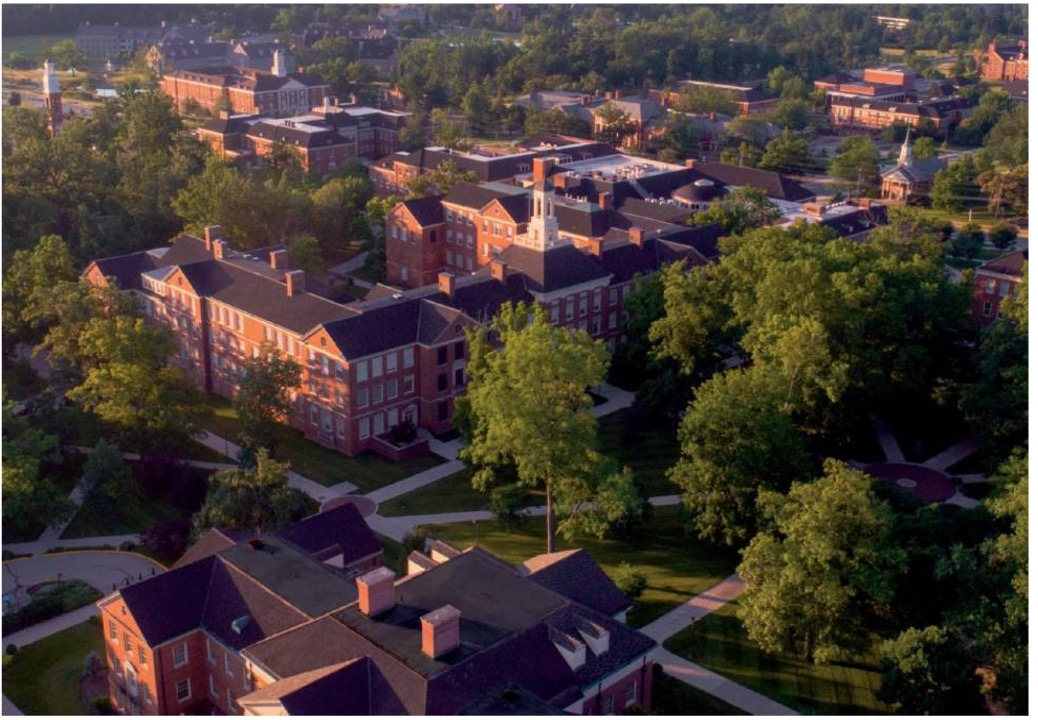
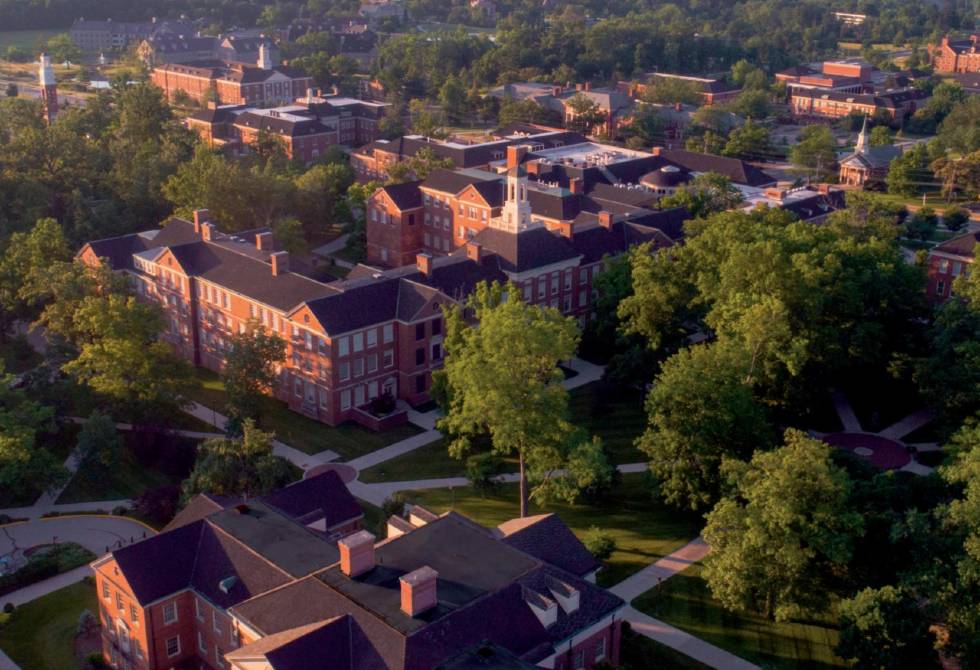
Miami University Campus
Ohio is home to many private and public universities, and I had opportunities to consider several options. I applied to three state universities, was admitted to all, and visited two. The Ohio State University, closest to home, overwhelmed me by its sheer size and its urban campus. I was never particularly serious about a second university, which I applied to as my “safety school.” But one visit to Miami University in Oxford Ohio and I knew where I wanted to be for the next four years. In my naivety, my immediate thought was “This looks like college!” With its neo-Georgian brick architecture, its quads and green spaces, its relatively small student population and its location in very small-town Oxford, it fit every image I had of college from books, movies, and television—and from the Wittenberg and Antioch campuses. I knew, too, that many people considered it the “best” of the public schools in Ohio, that it was, because of its small size, more selective than the others. Only later did I understand that this selectivity was deliberate. Miami is a “Public Ivy,” a term attributed to Richard Moll’s 1985 The Public Ivys: A Guide to America’s Best Public Undergraduate Colleges and Universities that describes Miami’s reputation even at the time I attended, almost 20 years before Moll’s use of it. Many of my classmates, especially those from the East coast, told me that Miami was their second choice, their first being a “real” Ivy League institution.
Miami proved to be the perfect place for me in the late 1960s and early 1970s. While it had graduate programs, it was primarily a teaching institution, and humanities courses were small, with faculty who prioritized teaching and students over research and scholarship. It was also, perhaps because of its location in a small town and its restrictions that did not allow undergraduates to have cars on campus, a place that, as Beth Nguyen puts it in her recent memoir, “had a way of making me feel removed from the world” (Nguyen 2023, 90-91). At least until the war in Vietnam made that impossible. But a benefit of feeling removed from the world, and one that I think remains part of the undergraduate experience for many students, is the opportunity to, as Kathi says in her interview, develop intellectually and socially, to expand what they understand to be possible. For me, that meant changing majors from accounting to English and then changing career goals from law school to graduate school so I could continue to study literature, continue to be on a campus, and eventually make the university my home as a faculty member.
From Miami, I went to Indiana University because that is where the professor who introduced me to Victorian literature told me I’d find the best program. Indiana was the only graduate school I applied to, and, naively, I did not apply directly to the Ph.D. program or for an assistantship. I was surprised to learn when I arrived that most of my first-year peers knew better, were in the Ph.D. program, and had fellowships or assistantships. But IU was, again, the right place for me. I was challenged to expand my understanding of “reading literature” to include scholarship and research and to become familiar with interdisciplinarity. And eventually, I had the opportunity to teach, where I learned that I did indeed want to be a professor.
As quickly became clear, I was not, however, likely to become a literature professor. In the mid-1970s, the bottom fell out of the literature market—and has continued to fall since then. But I liked teaching and I liked teaching composition, so I accepted a position as a lecturer at the University of Louisville, where I taught four sections of composition per semester and where, more importantly, I first learned that rhetoric and composition existed as a field of study, however nascent in 1976. Joseph Comprone had just arrived to become director of composition, and he introduced me and the other adjuncts and the graduate teaching assistants to scholarship in the discipline. An urban institution, the University of Louisville differed from both Miami and IU. The campus is in the heart of a large city and was not primarily a residential campus. Most of the undergraduate students I taught commuted from the metropolitan area, missing, I suppose, the feeling of being removed from the world that I experienced at Miami.
In quick succession, I moved from lecturer paid by the course at Louisville (1976-1977) to non-tenure-track assistant professor with renewable one-year appointments at Illinois State University (1977-1979) and then to tenure-track assistant professor at Tennessee Technological University (1979-1981). Illinois State had its origins as a normal school—a teacher’s college—and followed a common path to becoming a university. There, I had as colleagues people who regularly attended CCCC, and I joined them for my first conference, in Denver in 1978. Tennessee Tech was the first “overtly specialized” institution where I worked. Founded in 1915 as Tennessee Polytechnic Institute and renamed Tennessee Technological University in 1965,1 on the one hand Tennessee Tech saw itself as an innovative engineering university (the bookstore sold T-shirts proudly reading “MIT—The Tennessee Tech of the North”) and on the other attracted large numbers of first-generation high school graduates for whom the university was a very unfamiliar place. It also attracted a number of students from Iran2 who came to study engineering, supported by their government, and for whom a small university in a very small town in rural Tennessee was even more unfamiliar. Tech was on the quarter system during those years. Faculty in the humanities taught five courses per quarter, and in the English department, that meant almost always two sections of composition and two or three of required literature survey courses. I was appointed to work as a writing center co-director, yielding me a release from one literature course per quarter. During these years, I became more engaged with the field of rhetoric and composition. I continued to attend CCCC, to read professional journals, and to think of myself as part of this discipline. I knew that I could not achieve what I wanted with the teaching responsibilities I had at Tech. And I wanted to be with colleagues, like those I had at Illinois State, with whom I shared these professional interests.
1About Tennessee Tech - History (tntech.edu) accessed December 28 2023
2During these years, Iranian students made up the largest number of international students in the U.S., triple the number from Taiwan, the next largest country of origin International Students in US by Country of Origin - 1949/2020 - (statisticsanddata.org) accessed January 2 2024)
So, when in February 1981, Purdue advertised an assistant professorship with responsibilities for assisting the director of composition and administering a developmental writing program, I applied. I’d become familiar with the faculty at Purdue through my reading, and I knew there was a brand-new Ph.D. program in rhetoric, directed by Janice Lauer, as well as a writing center directed by Muriel (Mickey) Harris. The end result: an offer that I literally could not refuse.
When I accepted the offer, Janice Lauer encouraged me to come to Purdue during the summer to attend the two-week summer seminar in theories of teaching composition she had been offering since 1976, both at the University of Detroit and at Purdue since her arrival in 1979.3 Though she was too diplomatic to say so, it was clear to me that Janice recognized I had a lot to learn about rhetoric and composition and knew that my exposure to leaders in the field like Ross Winterowd, Ed Corbett, Richard Young, James Kinneavy, Janet Emig, and Louise Phelps would give me a start on that learning. It was also at the seminar that I met and became friends with the Ph.D. student who served as Janice’s assistant: Kathleen Blake Yancey.
3 For information about this influential seminar, offered at a time when there were very few Ph.D. programs in rhetoric and/or composition, see Janice Lauer, “Disciplinary Formation: The Summer Rhetoric Seminar,” JAC 18.3 (1998), pp. 503-508.
Purdue was my professional home for the next 40 years. It was where, through my work as Director of Developmental Writing, Director of Composition, Head of the Department of English, and Dean of the College of Liberal Arts, I developed my understanding of the modern U.S. university.
In her interview, Kathi responds to the question “What is the proper role of the university in American higher education?” by saying “to help students develop intellectually . . . [and] socially,” and “to be educated in the service of democracy.” In this response, I hear echoes of the first title that came to mind when I was invited to write about this topic: John Henry Newman’s The Idea of a University, two books (published separately in 1852 and 1859 and subsequently first published together in 1873) that constitute his articulation of what a university is. Newman’s lectures reflect a particular moment in time and his particular perspective as inaugural Rector of the Catholic University of Ireland, as I would argue that both Kathi’s comments and this essay do. Newman, Yancey, and I have in common our efforts to explain the role of the university, and frequently our thoughts overlap. Newman, for example, writes in the Preface, that the responsibility of the university is to teach “knowledge,” not practical skills, since the former is universal and the latter more particular—and narrow (Newman 1852). Kathi says “What I’m . . . not in favor of is thinking about universities as engines of employment.” In this, she and Newman are, I think, in agreement—though as I’ll suggest later, she, Newman, and I may be in the minority, especially when we think about 21st century universities. (Another perspective on this issue, one that has stayed with me since my undergraduate days, was offered late one night at a party, when the host Donald Daiker, a professor of English who became an important mentor to me and who remains a friend, said that he did not think business schools belong at universities. They were, in his view, vocational training.)
So, what do I think the mission of the public university is? In a word, it is Opportunity.
Since their origins (and there is ample debate and bragging over when and where U.S. public universities were founded), a key hallmark of public higher education has been the expansion of opportunities. Regardless of whether we believe that public higher education began at the College of William and Mary (1693), the University of Georgia (1785), University of North Carolina-Chapel Hill (1789) or at one of any number of institutions that claim to be first, it is important that these public institutions have over time not only expanded their curriculum but most importantly invited increasingly diverse students to attend. While women had separate (and unequal paths) to higher education since the 17th century, and private Oberlin College began admitting women to its baccalaureate programs in 1833, it was the University of Iowa in 1855 that became the first public university to admit women and men on an equal basis. The numbers of women enrolled in universities has continued to grow, supported in part by the passage of Title IX in 1972, and today more women than men attend and graduate from U.S. public universities.
The Morrill Acts of 1862 and 1890 contributed to this expansion of opportunity through the federal government’s granting land for the purpose of establishing public universities throughout the states. While land-grant universities, such as Purdue, have enabled hundreds of thousands of students to pursue education in “agriculture and the Mechanic arts,” much of the land for these universities was appropriated from Native American tribes, sometimes through treaties and sometimes through seizures, leading Tristan Athone and Robert Lee to coin the phrase “Land Grab.” (Lee and Ahtone 2020).
Other laws have opened doors to university, especially public university, education as well. The GI Bill of 1944, officially The Serviceman’s Readjustment Act, encouraged over 8 million World War II veterans to enroll in post-secondary education. Though the original bill expired in 1956, it has been reintroduced in various forms since then, and continues to expand opportunities for men and women who have served in the military. Not inconsequentially, the original bill also offered an alternative to returning veterans who otherwise would have flooded the post-war job market.
Similarly, though much too slowly and painfully, legislation began to address racial disparities in public higher education. The original Morrill Act excluded people of color; the 1890 act provided money rather than land for the establishment of universities for Black students in states where admission was restricted by race. The 1890 Land Grant Act was a start, but as we know, efforts to integrate and diversify student, faculty, and staff populations in public universities have seen limited success, despite the Civil Rights Act of 1964 and Affirmative Action, the latter essentially ended by a June 2023 Supreme Court decision.
Additionally, the opportunity provided by US higher education in general and public universities in particular has led to the enormous enrollment of international students. Though the enrollment numbers dropped during the early years of the COVID 19 pandemic, the numbers have come back strong, according to the Open Doors 2022 Report (U.S. Colleges and Universities). Over 1 million students from over 200 countries studied at U.S. higher education institutions in 2021-2022, with universities like Arizona State, University of Illinois, Purdue University, University of California-Berkeley, and University of Michigan each enrolling over 11,000 international students (Statista).
The strength and hope for U.S. higher education in general and public university education in particular lies in this history of increasing access and opportunities. Yet, as the mixed history I have been discussing demonstrates, these opportunities cannot be taken for granted. While I remain optimistic about the future of U.S. public higher education, I turn in the next section to some observations about changes in higher education that warrant concern.
In this section, I will offer some reflections on several major changes in universities I have observed over the decades I have lived in them. For the sake of organization and, I hope, clarity, I’ll group these changes under the headings Corporatization, Curriculum, Funding, Politicization, and Faculty. But these headings do not identify discrete concepts.
First, however, I want to say a little about what I believe has not changed: Students.
People who have taught for any length of time or at different institutions frequently are asked how students have changed over the years we have taught. My response has always been “not much.” Perhaps this is because I have always attended and always taught at public universities. At these universities, some students have been exceptionally well prepared, motivated, and knowledgeable about “good student behavior.” Some students have not been well prepared or able to conform to “good student behavior,” but they have almost always been motivated to succeed, especially when faculty are motivated to help them do so. Students’ motives for coming to public universities strike me as being what they always have been: to learn things that will help them be successful in their lives. This may seem so general as to be meaningless, but I don’t think that’s the case. Whether it’s because they believe that attending a university will translate into higher earning power or provide them with the necessary skills or knowledge or credentials to do what they want to do, most students pursue post-secondary education with an eye towards their future. (They may also do so because, like me and other first-generation college attendees, it was the assumed next step after high school, instilled by their families and their peers. They may also do so because they didn’t know what else they were going to do. Universities have long served the societal function of keeping young people who are at loose ends off the streets—or at least given them “streets” where there is space for them to come to terms with both their youth and their aimlessness.) Universities are places that offer students the opportunity to mature, to test their beliefs. Later in this essay, I’ll offer two examples—of protests based on the current war between Israel and Hamas and those 55 years ago during the war in Vietnam—that illustrate how students use universities as such testing grounds.
Also underlying the question about how students have changed is curiosity about whether students are more or less prepared than they were in the past. Perhaps it’s the nature of the public university, with its historic mission to educate not just the elite or the wealthy or gifted but to welcome all, but in my experience undergraduate students who enroll in our courses (and here I’ll focus on what I know best, first-year composition) have always had a wide range of abilities and interests and experiences when it comes to writing. I have always taught students who lack confidence as writers, who have not been successful writers, or who have been persuaded that they are not good writers because they haven’t learned whatever particular conventions people have told them are essential for writers. It is students like these, described in David Bartholomae’s (1985) “Inventing the University” and Lucille McCarthy’s (1987) “A Stranger in Strange Lands: A College Student Writing Across the Curriculum,” who can teach us most about how challenging and alien a place the university can be and can remind us about how important it is for us to understand that what we take for granted as teachers can be mysterious to students. I have also always taught students who enter my classes already able to meet most of the expectations I have—who lead me to wonder when they leave the class if I have taught them anything.
Now on to some of the key changes I have observed.
I’m sure that in the late 1960’s when I first became part of the world of public universities, there were relationships between corporations and universities. Such relationships were not, however as pervasive and overt as they are today. I’ll cite just a few examples.

The B1G (10?)
First, and perhaps most obviously, intercollegiate athletics are big business, supported and increasingly shaped by corporate interests. Universities sign contracts with athletic-wear corporations, with food and beverage vendors, and so on. Increasingly, television revenues drive the fundamental organization of athletic conferences, especially the so-called Power Five, to the extent that on the day that I write this paragraph, my local newspaper published an article by USA Today sports columnist Dan Wolken titled “Michigan vs. Washington national title game marks the end of college football as we know it.” Wolken writes about the shifting composition of athletic conferences, noting that they were originally regionally cohesive groupings of institutions. The Big Ten, for example, was until recently composed of major universities from six midwestern states: Ohio, Indiana, Illinois, Michigan, Wisconsin, Minnesota, Iowa. Then Penn State (1990) to the East and Nebraska (2011) to the West joined the conference. There was some logic to these additions, given that these universities were located in states contiguous to the original six and are, like the majority of the original 10, land-grant universities. In 2014, two more land-grant universities, Rutgers and the University of Maryland joined the Big 10, an expansion based on the very large television audiences in the New Jersey/New York and Washington DC areas. Anticipating the 2024-2025 season that will bring four more universities to the Big Ten (as illustrated above, Big Ten Conference), two more to the SEC, etc., Wolken notes “These are no longer cohesive leagues that were built on academic and cultural commonality, they’re chain restaurants trying to plant their flag in every suburban shopping center with foot traffic and good parking. You might as well root for Chipotle and Starbucks,” and points out that “the real argument is about which [conference] makes the most money from its television contracts” (Wolken, 2024).
Corporate money increasingly plays a role in other aspects of university life. Echoing Wolken’s reference to chain restaurants, what were once in-house dining facilities have been replaced by franchises as diverse as Chick-fil-a and Au Bon Pain.
Corporate control of intercollegiate athletics and food services can, of course, be understood as practical ways of making shrinking public funding stretch further. Universities are quick to point out that the money from television and other corporate contracts support collegiate athletics and provide scholarship money for students beyond those who participate in sports. But corporatization is increasingly interwoven with the traditional academic and research missions of universities. At Purdue, both Rolls Royce and Saab have facilities focused on aviation and aerospace research, both fields that have been traditional strengths of Purdue (think Amelia Earhart, an academic advisor and consultant at Purdue in the mid-1930s and the numerous astronauts, including Neil Armstrong and Virgil “Gus” Grissom, who have earned Purdue the nickname “Cradle of Astronauts.”)
In fact, Armstrong’s moon-landing first words have become part of Purdue’s marketing, in particular the phrase “giant leap.” For a number of years, billboards along Interstate 65, both North and South of West Lafayette, emphasized the opportunity for students to take that “giant leap” at Purdue.
Just recently, however, those billboards have been replaced by the one pictured at the beginning of this essay, one that presents a different, and to me more disturbing characterization of Purdue. These billboards tout Purdue as the “16th most innovative company [emphasis mine] in the world,” a designation from Fast Company magazine’s annual Top 50 Most Innovative Companies list and the only university named, in this particular case for its role in semiconductor development.
As I said, I find these billboards disturbing. I see in them not merely a marketing decision but in proudly identifying Purdue as a “company” also a turning away from the broader mission of universities to provide a breadth of educational opportunities for students—to prepare them not just as scientific and technological innovators and business leaders but as citizens as well. It behooves us to be attentive to the potential for corporate connections to drive curriculum and research.
One reason that public universities turn to corporations for support is that states have, over years, reduced the amount of financial support they provide universities. Anyone who has worked at a public institution knows this, but the most recent details about this shift can be found in the November 08 2024 Chronicle of Higher Education, where Brian O’Leary and Julia Piper present data on “State Support for Public Colleges, 2002-22.” The article is a comprehensive table including over 1500 public colleges and universities, and presenting clearly the ten-year change in state support. In my state of Indiana, the two largest public universities, Indiana University-Bloomington and Purdue University-West Lafayette have experienced, respectively a -9.6% and a +0.7% change (O’Leary and Piper).
Reductions in state funding have impacted universities in several ways. Tuition has increased dramatically at most public (and private) universities. At public universities, decisions about the balance of in-state, out-of-state domestic, and international students are influenced by funding. University administrators balance the need to demonstrate to legislatures and the broader public that they continue to serve in-state students with the bottom line. More and more, faculty are encouraged to pursue external support for their research, both from government agencies and from corporations.
In his influential “Rhetoric and Ideology in the Writing Classroom,” James Berlin writes: “Every pedagogy is imbricated in ideology, in a set of tacit assumptions about what is real, what is good, what is possible, and how power ought to be distributed” (Berlin 1988, 492). He argues that most current rhetorical theories can be co-opted, “made to serve specific kinds of economic, social, and political behavior that works to the advantage of members of one social class while disempowering others . . .” (Berlin 1988, 492.) Such is certainly the case at West Virginia University, where according to the article cited above, the funding “formula . . . particularly prizes degrees that are designated as state priorities for workforce development, including engineering, health care, social work, education, computer science and transportation,” while a number of degree programs and faculty positions in the arts and languages, among other areas of study, were either eliminated or dramatically reduced.
I offer here two additional examples of how ideology threatens the open exploration of ideas that have long been the hallmarks of university education. First, as reported in “The Right-Wing Attack on Academia, With a Totalitarian Twist," John. K. Wilson warns about the General Education Act, a joint proposal by three conservative groups: The National Association of Scholars, the Ethics and Public Policy Center, and the James G. Martin Center for Academic Renewal. The Act seeks to introduce a new 42-credit general education curriculum at public colleges and universities. Wilson points out that “The sole U.S. history course ends in 1877. The only U.S. literature course, explicitly devoted to ‘great books,’ stops at 1914,” and so on. As frightening and perhaps as far-fetched as this campaign may appear, the Cornerstone Integrated Liberal Arts program at Purdue University offers an example of this steeped-in conservative politics curriculum, with an emphasis on “transformative texts — the greatest that has been thought, said, and written across human history” (College of Liberal Arts). At Purdue, the Cornerstone curriculum is not a universal general education requirement, but several colleges at Purdue have either required students to participate or strongly encouraged them to do so.
Second, and I would argue related to GEA efforts, are the efforts of politicians, most notably Florida Governor and recent Republican presidential candidate Ron DeSantis, to dictate how history, particularly history related to race, is taught—or more accurately not taught—and to dismantle DEI (Diversity, Equity, and Inclusion) programs and related teaching. In both the GEA initiative and the “anti-woke” actions in Florida (Brooks), Utah (Zahneis), Wisconsin (Gretzinger) and elsewhere, open inquiry is at risk of being replaced by conservative political perspectives that erase historical facts, particularly those that challenge a narrow, white, male, and heterosexual narrative.4
4 Rather than detail the many articles and the detailed data available about these issues, I recommend that readers follow The Chronicle of Higher Education’s “DEI Legislation Tracker”
Interference in the curriculum as outlined above cannot easily be separated from increasing politicization. One could argue, as I did with myself when writing this, whether the attacks on DEI are curricular or political, as the proposed constitutional amendment in Wisconsin cited above demonstrates. They are both, and the distinction is not as important as the danger. The recent action by the Florida Board of Governors replacing sociology courses as options for fulfilling a graduation requirement for a social science course with “a course called “Introductory Survey to 1877, . . . which will provide a ‘historically accurate account of America’s founding, the horrors of slavery, the resulting Civil War, and the Reconstruction Era’,” is another example of the politicization of the curriculum. Most members of this board, as is commonly the case with such boards, boards of trustees, and other oversight and governing bodies, are appointed by the Governor (Somasundaram and Natanson).5
5The majority of this particular Board of Governors was appointed by Governor Ron DeSantis. I note also that the history course required as to meet the graduation requirement ends exactly where the history course in the GEA proposal ends. Not likely a coincidence. Florida state university system removes sociology as core course option - The Washington Post
A final recent example, one fraught with complexity, is the recent request by the House Committee on Education and the Workforce that the presidents of Harvard, University of Pennsylvania, and MIT testify about antisemitism on their campuses following the October 7 attack by Hamas on Israel. There is wide agreement that the three university presidents should have been more willing to condemn calls for intifada and calls for genocide on their campuses, to say clearly whether or not such calls violated their institutions codes of conduct. Instead, each tried to walk a narrow path, distinguishing between protected speech and conduct, the latter of which would clearly be unacceptable and punishable. As problematic as their responses were, that they were asked to testify and that much of the probing came from Representative Elise Stefanik, a New York Republican described in a CNN story as “a Trump-aligned lawmaker with a penchant for stoking outrage” (Morrow) serves as a reminder that the university and its leaders are potential foci for politicians and political critique. These inquiries continued, with Columbia University’s president Nemat (Minouche) Shafik being called to testify in April 2024. Shafik announced her resignation on August 14; Harvard’s Claudine Gay and University of Pennsylvania’s Liz Magill lost their jobs earlier this spring (Brown and Thomason).
While these institutions are private, similar protests and similar responses have occurred at both private and public universities across the country, including Indiana University-Bloomington, Arizona State University, UCLA, and many others.6 For those of my generation, the encampments and protests are reminiscent of those many of us participated in during the late 1960’s and early 1970’s at the height of the war in Vietnam. While the situations that led to these protests differ in many ways, both speak to how at least some university students engage in the world (a counterexample to Beth Nguyen’s observation that universities provide places to be “removed from the world”) and how university administrators and legislators respond to that engagement.7 Such political action on the part of students and faculty, as well as similar actions with respect to racism, sexism, and issues of gender identity, exemplify the role the university can play in a democracy.
6In early May 2024, The Chronicle of Higher Education published an article reporting on some of the institutions where encampments have been established and arrests have been made. See Sonel Cutler, Forest Hunt, and Alecia Taylor: “How Colleges Have Responded to Student Encampments,” May 1, 2024 We Looked at 50 Colleges to See How They Handled Student Encampments. Here’s What We Found. (chronicle.com).
7Unfortunately, too often the institutional responses involve calling in police and/or National Guard to attempt to bring protests to an end. At Miami University, the occupation of the Naval ROTC building on April 15, 1970 led to arrests, as have responses to the recent encampments and protests on campuses across the country. On May 4, 1970, a little more than two weeks after the Miami University occupation, at Kent State University four students were killed by Ohio National Guard members in a tragic over-reaction to protests on that Ohio campus. Not long after, Crosby, Stills, Nash, and Young wrote and released the song “Ohio,” their powerful response to those killings: Crosby, Stills, Nash, and Young "Ohio" (youtube.com).
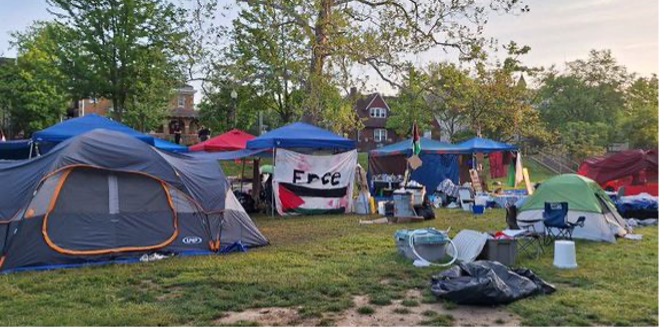
Dunn Meadow, Indiana University-Bloomington May 2, 2024 (Sandweiss)
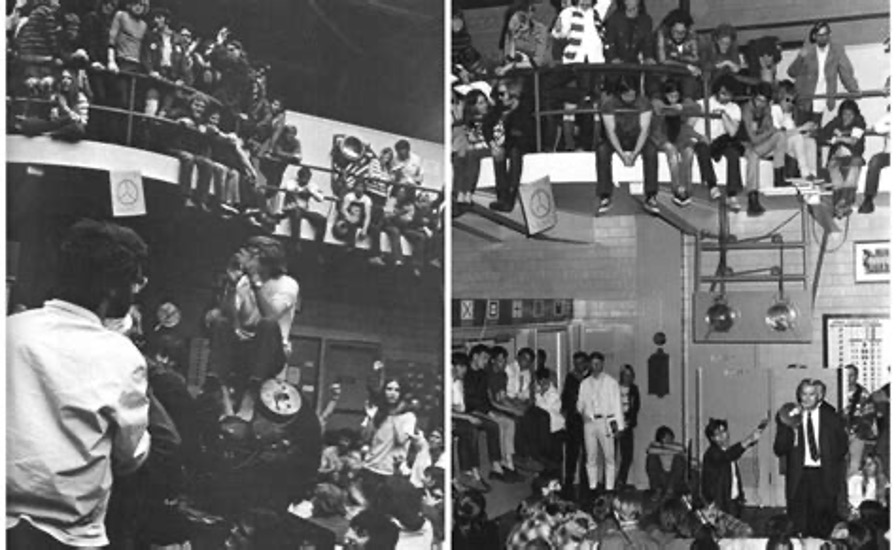
Occupation of Rowan Hall (Naval ROTC Building) Miami University April 15, 1970 (WXVU)
Finally, a few words about faculty. As I suggested at the beginning of this essay, faculty play a central (perhaps the central) role in what students take from their university experience. Traditionally, the concept of academic freedom and the system of peer review and tenure have enabled faculty to pursue and convey knowledge with few constraints. I do not want to imply that only tenure-track and tenured faculty are effective teachers or insightful scholars. I know too many talented and dedicated contingent and non-tenure track faculty to believe this. But it is certainly the case that the make-up of the faculty continues to change. As I mentioned earlier, my first two academic positions, in the mid- to late-1970s, were not tenure-track. The path I followed from non-tenure track to tenure-track and tenure was, however, common. It remained so for many years. That, however, has changed. The AAUP “Data Snapshot: Tenure and Contingency in US Higher Education,” summarizes “National Center for Educational Statistics (NCES) data on patterns of faculty appointments . . . from fall 1987 through fall 2021” (Colby). The data show that “Over two-thirds (68 percent of faculty members in US colleges and universities held contingent appointments in fall 2021, compared with about 47 percent in fall 1987” (Colby). The data also show that women and underrepresented minority faculty held contingent appointments in greater proportions than men and non-URM faculty members in fall 2021. Another AAUP report includes data on the replacement of tenure lines with contingent appointments over a five-year period ending in 2022, breaking down the information by public and private, degrees granted, and size. Not surprisingly, public institutions report the highest percentage of contingent replacements for tenure lines (Tiede).
There are a number of reasons for this change, related to the previous topics I have discussed. Funding is one obvious reason. Contingent faculty do not cost universities as much as tenured or tenure-track faculty. They are rarely paid as much, even if they are full-time and receive benefits. If they are part-time, they are often paid per course, with no benefits. And they often teach more, as is the case for the non-tenure track faculty in Purdue’s Cornerstone program, many of whom teach as many as four 30-student so-called writing intensive courses per semester, as opposed to the typical two course per semester assignment for tenure-track and tenured faculty, so the cost per section is much lower. A second, more problematic, reason for this change is political. In his 2021 discussion of threats to tenure and academic freedom, Mark J. Drozdowski cites recent attempts to curtail or end tenure and to constrain academic freedom by legislatures in South Carolina, Iowa, and Georgia. Drozdowski notes that some legislators in these states have linked these efforts with a desire to constrain faculty free speech, which they view as indoctrination. In Indiana, as in these and other states, the legislature passed and, on March 13, 2024, Governor Eric Holcomb (R), signed into law Senate Bill 202, which, under the guise of free inquiry and expression, states among other things:
Requires the establishment of certain policies regarding: (A) disciplinary actions for certain persons that materially and substantially disrupt protected expressive activity; (B) limiting or restricting the granting of tenure or a promotion if certain conditions related to free inquiry, free expression, and intellectual diversity are not met; and (C) disciplinary actions that will be taken if, after a review, a determination has been made that a tenured faculty member has failed to meet certain criteria related to free inquiry, free expression, and intellectual diversity. (Indiana Senate Bill)
Such politically based attacks on tenure and the increasing reliance on contingent faculty put more control of education in the hands of politicians, control that extends from budget to curriculum—who teaches and what they teach. It is too soon to tell how these attacks and legislation may play out, but an article in the August 7, 2024 Inside Higher Education titled “A Big Chunk of Professors Flunked U of Florida Post-Tenure Review” (Quinn) indicates their dangerous potential and emphasizes the need for all who value free inquiry to be vigilant. As Kathi comments in her interview, such actions are among the reasons that faculty (and graduate students and other university employees) turn to unionization—it gives them the opportunity to drive change and to protect their rights.
Despite the disturbing changes I’ve described above, I remain optimistic about the future of public universities (and higher education “writ large,” as Kathi notes in her interview). My optimism comes from the continuing relationship between students and faculty, the former coming to universities for the opportunities to learn, think, and mature I mentioned earlier, and the latter who remain committed to pursuing and sharing knowledge, to understanding and improving the human condition, and to helping students prepare to do the same. The continued appeal of higher education, including the appeal to international students mentioned earlier, is evident in the Fall 2023 data from the National Student Clearinghouse Research Center, which notes that across institutional types, “Undergraduate enrollment grew for the first time since the beginning of the pandemic” (National Student Clearinghouse), and many public universities across the country reported record enrollments. We must, however, remain aware of the kinds of threats to the core mission of university education I have outlined above. We must be willing to speak and vote in ways that support this mission. In doing so, we can assure that universities continue, as Kathi says (and I repeat here): “to help students develop intellectually . . . [and] socially,” and “to be educated in the service of democracy.”
Bartholomae, David. 1985. “Inventing the University.” In When a Writer Can’t Write: Studies in Writer’s Block and Other Composing Process Problems, ed. Mike Rose, 273-28. New York: Guilford.
Berlin, James. 1988. “Rhetoric and Ideology in the Writing Classroom.” College English 50 (5): 477-494.
Big Ten Conference. 2025. https://images.contentstack.io/v3/assets/bltca750cef518bc6e4/blt47369c007725f817/687030029230971beac9afb3/endframe.sky.png?auto=webpll. Accessed August 16, 2025.
Brooks, Peter. 2024. “Teaching Ignorance in Florida,” The Chronicle of Higher Education. February 6, 2024 https://www.chronicle.com/article/teaching-ignorance-in-florida. Accessed August 16, 2025.
Brown, Sarah and Andy Thomason. 2024. “Columbia’s President, Whose Response to Protests Ignited Encampments Nationwide, Resigns Suddenly” The Chronicle of Higher Education. August 14, 2024 Columbia’s President, Whose Response to Protests Ignited Encampments Nationwide, Resigns Suddenly (chronicle.com). Accessed August 17, 2025.
Colby, Glenn. 2023. “Data Snapshot: Tenure and Contingency in US Higher Education.” Academe Magazine. Data Snapshot: Tenure and Contingency in US Higher Education | AAUP. Accessed August 17, 2025.
College of Liberal Arts. “Cornerstone Integrated Liberal Arts.” Cornerstone Integrated Liberal Arts - College of Liberal Arts - Purdue University. Accessed August 16, 2025.
Crosby, David, Stephen Stills, Graham Nash, and Neil Young. 1970. “Ohio” Crosby, Stills, Nash, and Young "Ohio" (youtube.com).
Cutler, Sonel, Forest Hunt, and Alecia Taylor “How Colleges Have Responded to Student Encampments,” The Chronicle of Higher Education. May 1, 2024 We Looked at 50 Colleges to See How They Handled Student Encampments. Here’s What We Found. (chronicle.com). Accessed August 17, 2025.
Drozdowski, Mark J. 2021. “Tenure Under Attack Nationwide,” Best Colleges. Tenure Under Attack Nationwide | BestColleges Accessed August 17, 2025.
Gretzinger, Erin. 2024. “Wisconsin Republicans Open New Front Against Campus DEI With Proposed Constitutional Amendment,” The Chronicle of Higher Education, January 31, 2024 https://www.chronicle.com/article/wisconsin-republicans-open-new-front-against-campus-dei-with-proposed-constitutional-amendment?utm_source=Iterable&utm_medium=email&utm_campaign=campaign_8917451_nl_Academe-Today_date_20240201&cid=at. Accessed August 16, 2025.
Indiana Senate Bill 202. 2024. “State Educational Institution Matters.” IN SB0202 | 2024 | Regular Session | LegiScan. Accessed August 17, 2025.
International Students in US by Country of Origin - 1949/2020 - (statisticsanddata.org) accessed January 2, 2024.
Lauer, Janice. 1998. “Disciplinary Formation: The Summer Rhetoric Seminar,” JAC 18 (3): 503-508.
Lee, Robert and Tristan Ahtone. 2020. “Land-grab Universities,” High Country News March 30 2020. Land-grab universities - High Country News Accessed August 15, 2025.
McCarthy, Lucille Parkinson. 1987. “A Stranger in Strange Lands: A College Student Writing Across the Curriculum.” Research in the Teaching of English 21(3): 233-265.
Miami University. N.D. aerial-oxford-campus-over-upham.jpg (980×670) (miamioh.edu). Accessed August 15, 2025.
Moll, Richard. 1985. The Public Ivy’s: A Guide to America’s Best Public Undergraduate Colleges and Universities. New York, NY: Viking.
Morrow, Allison. 2023. “How Harvard, Penn and MIT’s presidents made such a fatal error in their free speech defense.” How Harvard, Penn and MIT’s presidents made such a fatal error in their free speech defense | CNN Business. Accessed August 17, 2025.
National Student Clearinghouse Research Center. 2024. “Stay Informed.” Stay Informed - National Student Clearinghouse Research Center. Accessed August 17, 2025.
Newman, John Henry. 1852. The Idea of a University Defined and Illustrated in Nine Discourses Delivered to the Catholics of Dublin. The Project Gutenberg EBook of The Idea of a University Defined and Illustrated: In Nine Discourses Delivered to the Catholics of Dublin by John Henry Newman. Released February 5, 2008.
Nguyen, Beth. 2023. Owner of a Lonely Heart. New York, NY: Scribner.
O’Leary, Brian and Julia Piper. 2024. “State Support for Public Colleges, 2002-22.” Chronicle of Higher Education. How Public-College Funding Has Changed Over Time. Accessed August 16, 2025.
Purdue University. 2023. “Check out our billboard.” Check out our billboard celebrating... - Purdue University | Facebook. Accessed August 15, 2025.
Quinn, Ryan. 2024. “A Big Chunk of Professors Flunked U of Florida Post-Tenure Review,” Inside Higher Education. August 7, 2024. A big chunk of professors flunked UF post-tenure review. Accessed August 17, 2025.
Statista. 2025. U.S. universities with the most international students 2023/24 | Statista. Accessed August 15, 2025.
Sandweiss, Ethan (Photo credit). 2024. “Morning at the encampment at Dunn Meadow, May 2.” “Voices from the Encampment” posted by Alex Chamber, May 24, 2024. Voices from the Encampment | Inner States - Indiana Public Media. Accessed August 17, 2025.
Somasundaram, Praveena and Hannah Natanson. 2024. “Florida Removes Sociology as Core Course Option for Public Colleges.” The Washington Post. Florida state university system removes sociology as core course option - The Washington Post. Accessed August 17, 2025.
Tennessee Technological University. About Tennessee Tech - History (tntech.edu) accessed December 28, 2023.
Tiede, Hans-Joerg. 2022. The 2022 AAUP Survey of Tenure Practices. AAUP. The 2022 AAUP Survey of Tenure Practices | AAUP. Accessed August 17, 2025.
U.S. Colleges and Universities See Strong Rebounds in International Student Enrollments | IIE - The Power of International Education. 2022. Accessed August 15, 2025.
Wilson, John K. 2023. “The Right-Wing Attack on Academia, With a Totalitarian Twist.” Inside Higher Education. A new front in the right-wing attack on academia (opinion). Accessed August 16, 2025.
Wolken, Dan. 2024. College football changing forever after Michigan-Washington title game (usatoday.com). Published 6:04 a.m. ET Jan. 4, 2024. Updated 9:47 a.m. ET Jan. 8, 2024.
WXVU. 1970. 50 Years Later: Miami University's 'Tipping Point,' Rowan Hall's Vietnam War Protest | WVXU. Accessed August 17, 2025.
Zahneis, Megan. 2024. “Diversity Offices, Statements, and Training Are Banned in Utah’s Public Colleges,” The Chronicle of Higher Education. January 31, 2024. https://www.chronicle.com/article/diversity-offices-statements-and-training-are-banned-in-utahs-public-colleges?utm_source=Iterable&utm_medium=email&utm_campaign=campaign_8917451_nl_Academe-Today_date_20240201&cid=at. Accessed August 16, 2025.