




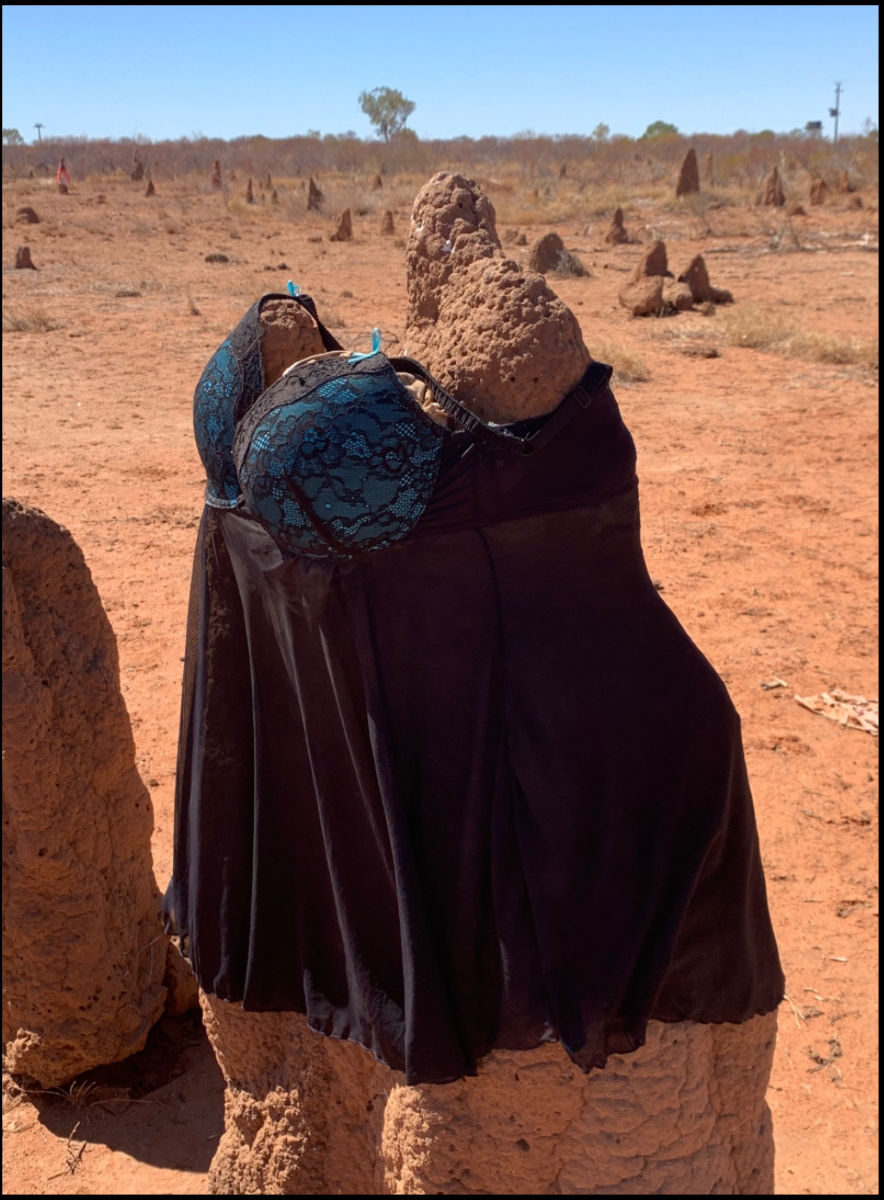

Appearing in the 1970s along the Stuart Highway in Australia's Northern Territory, termite mounds created by N. triodiae--the cathedral termite--were re-mediated by humans as "mound people" (Morgans). Using a combination of "raw creativity" (Morgans) and fashion--from sports regalia to bras and beer cans--the mound people exist at the familial intersection of Hominid and Termitoidae (Smith). Smith (2019), professor of archaeology finds these "snowmen" endlessly fascinating for the insights they provide into "fundamental human behaviors" (third para.).
But even more so, the bedecked and bedizened mounds provide insights into the ethics of sympoietic rhetorical behavior. Oddkin Yancey demonstrates both the necessity for and the practice of rhetorical accountability in compos(t)ing.
Mud Tube
He [Ian Hance] said dressing up the mounds did not cause any harm to the termites.
--Elliana Lawford, “Daleks, Santa Calus, Nude Women: Northern Territory’s Costumed Termite”
But what did the termites say?
Bitzer and (Absent) Responsibility
Oddkin Yancey performs her agentive co-constitution and porous materialities across different contexts with multiple overt and covert collaborators, thereby laying a foundation for both critiquing and transmuting Bitzer’s rhetorical situation. In the process, she adumbrates a new “genuine rhetorical situation,” one that includes elided subjectivities and textur-alities. However, the value of her work for reconceptualizing rhetorical situation as sympoietic goes beyond these significant accomplishments to include ethics, a central element of both oddkin sympoiesis and rhetoric writ large.
Using the trope of the “intersecting gaze”—a moment of reciprocal looking-with (rather than looking-at)—Haraway (2008) notes as much, claiming that an ethical imperative haunts not only sympoiesis but also sympoietic rhetoric, from “polite greeting” to “constituting the polis” (p. 19). Ethics, then, she continues, is integral to any place or situation “where and when species meet” (p. 19).
Communication scholar Hyde (2011) reinforces Haraway’s (2008) connection between a wide-ranging rhetoric and ethics, situating ethics “at the heart of human being” (p. 31) and asserting ethics’ centrality to “the ‘places,’ ‘habitats,’ and ‘haunts’. . . wherein people dwell and bond together” (p. 33). His insistence on ethical communication where people meet, aligns with Haraway’s insistence on response-ability in any act of making-with, biological and non-biological, visual and linguistic. “Making kin. . . troubles important matters, like to whom one is actually responsible. Who lives and who dies and how in this kinship rather than that one? What shape is this kinship, where and whom do its lines connect and disconnect, and so what?” (p. 2), all ethical questions pertinent to rhetoric and to living.
Oddkin Yancey implicitly embraces both Haraway’s response-ability as well as Hyde’s ethical rhetoric, recrafting each into rhetorical accountability, thereby healing a troubling absence in Bitzer’s model of rhetorical situation.
While Bitzer (1980) does say that a “rhetorical work is analogous to a moral action rather than a tree,” he never specifies any particular relationship between moral situations and rhetorical situations (p. 23). In addition, while Bitzer concedes that humans are “ultimately responsible for many of its [environment’s] constituents and qualities” (p. 23), what that responsibility entails remains unarticulated. Similarly, while “situation controls the rhetorical response,” Bitzer (1968) omits any ethical entailment to that response, an omission Brinton (1981) reinforces. In his “clarification” of Bitzer’s rhetorical situation, Brinton also concludes that any “normative” theory (such as Bitzer’s, in Brinton’s view) is not and need not be an “ethics of persuasion” (p. 237). While it may parallel ethical concerns, it is not itself be ethical (p. 237).
But Vatz (2009) takes issue with this very separation, labeling both Bitzer’s 1968 and 1980 articles as “ethically irrelevant” (p. 1). He (1973) protests that “the ethical implications for this rhetorical perspective are crucial” especially Bitzer’s implied ethical immunity of the rhetor (p. 158). As Vatz explains, “If one accepts Bitzer’s position that ‘the presence of rhetorical discourse obviously indicates the presence of a rhetorical situation,’ then we ascribe little responsibility to the rhetor with respect to what he has chosen to give salience” (p. 158). As a result, he concludes, Bitzer’s rhetorical situation verges on ethical bankruptcy.
Oddkin Yancey redresses Bitzer’s omission by performing rhetorical accountability. She embraces Hyde’s claim that rhetoric’s “relationship with ethics is, to say the least, immense and complex,” (31). What is even more importance, she embraces the obligation of human existence, which “places before us the challenging tasks of ethical responsibility, freedom of choice, thoughtful action, living a meaningful life, and being with others” (34). Resonating to Haraway’s response-ability, Yancey remediates its three components—respectful-caring, calculating consequences, and vigilance—into an ethics for a sympoietic rhetorical situation.
Mud Tube
There is material evidence that the snowman tradition has some longevity. In some cases, the clothing is in a dilapidated state. In others, the termites have renewed their building efforts on top of the clothes.
--Claire Smith, “What the Terminte Mound ‘Snowmen’ of the NT Can Tell Us About Human Nature”
An Ethical Moment: A Story in Four Texts
While oddkin Yancey’s three-part rhetorical accountability can be traced across her scholarship as an implicit presence, this repurposing of Haraway’s (2016) oddkin response-ability plays out vividly and dramatically across four different texts, all linked by ethical concerns emerging from the phenomenon of digital textur-alities especially as embodied by the new essay form. Rhetorical accountability unfolds across these four texts in two moves.
The first move—which might be called the moment of the intersecting gaze, or the meeting point between two divergent views —involves Yancey and Spooner’s (1996) “Postings on a Genre of Email” and Kirsch’s (1997) “Multi-Vocal Texts and Interpretive Responsibility”; jointly the two very different print publications bring into focus this intersecting gaze and the ethical question it poses about rhetorical accountability.
The ethical cuing begins with Kirsch’s (1997) College English opinion essay, published after Spooner and Yancey’s “Postings” in College Composition and Communication, an article in the new essay genre. Concerned with the proliferation of non-traditional essay genres in and out of the discipline, Kirsch poses an ethical question: where does the interpretative responsibility lie given the demands of new or alternative textur-alities on readers? For Kirsch, the rising occurrence of “multi-vocal texts,” such as “Postings,” which Kirsch cites as a specific example of the new essay form (p. 192), raises serious issues for various stakeholders.
Specifically, Kirsch (1997) worries about the “potential effects on readers, writers, and public discourse” (p. 191) in terms of “readability, accessibility, and interpretation” (p. 193). Her multifaceted concerns range from the failure of the new essay to illuminate the “cultural, social, and material differences” of the diverse voices cited (p. 194) to the need to guard against misappropriating, repressing, and/or colonizing voices (p. 197); her fears also include the potential to alienate the public to the rise of disciplinary elitism. In brief, Kirsch asserts that “experimental forms of writing do not help scholars to come to terms with interpretive responsibility” (p. 197). Therefore, she pleads, “we must learn to make conscious, deliberate decisions about when to write multivocal texts and when not to write them” (p. 197).
An implicit invitation to make-kin ethically in a sympoietic rhetorical situation circulates across these two essays. Kirsch’s (1997) gaze explicitly intersects that of Spooner and Yancey (1996) offering an opening for response. In the second move in this story of an ethical moment, Vielstimmig (1998, 1999) takes up Kirsch's implicit invitation.
The second move, predicated on the first two texts and extending across two more, embodies oddkin Yancey’s performance of rhetorical accountability with its three orientations. It encompasses Vielstimmig’s (1998) “Not a Cosmic Convergence,” which serves as a stage for the enactment of two processes constituting rhetorical accountability: respectful-caring and calculating consequences. Then, Vielstimmig’s (1999) “Petals on a Wet, Black Bough,” an exemplar of the new essay genre in press in 1998 when “Not a Cosmic Convergence” appeared in Kairos (p. works cited), continues the story of rhetorical accountability in a sympoietic rhetorical situation by illuminating the ethical duty of vigilance. [1]
[1] While this discussion of vigilance limits itself to a single essay, the process of monitoring the consequences of the new essay form extends also to “A Play on Texts” (Vielstimmig, 2001) as well as other Yancey-authored articles, individually and co-written, addressing the porous materialities of technology-literacy. Especially noteworthy is Yancey’s presentation at the 2004 Conference on College Composition and Communication, a visual-verbal performance remediated in print format in the December 2004 issue of College Composition and Communication. It is an outstanding example of calculating consequences and embracing the responsibilities dictated by the contribution of “the technologies of writing. . . to the creation of new genres” (298) and pedagogies.
Mud Tube
Indigenous Australians [First Peoples] also use insects for purposes other than food. Recent linguistic and ethnobiological research reveals additional uses of insects as bait, medicines, poisons, adornments, toys, and technology, while also serving as indicators of meteorological and other ecological phenomena.”
--Aung Si and Myfany Turpin, “The Importance of Insects in Australian Aboriginal Society: A Dictionary Survey”
Orientation: Respectful-Caring
A foundational commitment of Yancey’s rhetorical accountability involves respectful-caring, an affective obligation Yancey alludes to, especially in terms of the new digital essay genre. Spooner and Yancey (1996) make this obligation clear: the new essay genre is “transactive—not plain exposition, not pure narrative. . .. It’s affectionate—full of affect” (p. 258). It is at times “telegraphic” and “oblique," even sometimes including “a sort of lover’s code” (p. 258). Such affective intertwining is the means by which any rhetorical act initiates and maintains a “response relationship” where participants perceive each other as subjects rather than objects (Haraway, 2016, p. 24).
For rhetorical sympoiesis to emerge from an intersecting gaze, respectful-caring, according to Haraway, can only come into play when it overcomes “the fear of the stranger, the one thought to be out of place, the alien, the immigrant, the Indigenous” (Haraway, 2018, p. xlvii). Respectful-caring assuages that fear. Like Hyde (2011), who sees the language of morality as “the language of responsiveness and responsibility that is called for by the ontological workings of human being” (p. 34), Haraway (2016) also couples response and response-ability, placing care at the heart of both. As she delineates, respectful-caring dissipates fear of the other by grounding itself in “seeing again” or respecere: “To hold in regard, to respond, to look back reciprocally, to notice, to pay attention, to have courteous regard for, to esteem” (2008, p. 19) With regard—eyes wide open—sympoiesis as the “carrier bag for ongoingness” not only occurs but also sustains itself (2016, p. 124).
Yancey displays that caring orientation across her scholarship in diverse ways, reflecting the myriad practices by which strangers become allies, even if only temporarily. For the Myka Players (1998) in “Not a Cosmic Convergence,” respectful-caring in response to Kirsch unfolds according to the guidelines of “visiting”—the dynamic of hosting and guesting that Haraway offers as one mode of respectful-caring.
Visiting as set of practices for respectful-caring in rhetorical accountability guides the behavior of host (rhetor/Vielstimmig) and guest (cited scholar/Kirsch).[1] For instance, Haraway describes good hosts as those who make guests feel welcome by displaying honest interest in their guests’ concerns and wellbeing, politely cultivating “the wild virtue of curiosity” as a means of communicating warm regard and promotion a positive relationship necessary for making-with (p. 127). Vielstimmig as a metaphorical host to Krisch does exactly that.
[1]Lu (1999) reinforces the importance of respectful-caring, especially in terms of citation practices. Borrowing from Cornel West, Lu offers the concept of critical affirmation—a desire to “‘accent the best of each other’” even amid radical disagreement (West, qtd. by Lu 172)—as a desirable orientation to literacy, including “responding to others” in an academic setting (p. 172).
Before the webtext even introduces Kirsch by name (p. six), it prepares for her textual guest status by creating a hospitable environment that encourages conversation. To illustrate, the “hosts”—the Myka Players’ characters—establish common ground with Kirsch. They do so elliptically by discussing Cubist art and its spatial dramatization of “juxtaposition and disruption” as a “useful analog to a collagic essay approach” (p. four). By aligning the controversial characteristics of the new essay genre—a genre Kirsch both admires and critiques—with equally controversial characteristics of Cubism at its emergence in the early twentieth century, the hosts display respect for Kirsch’s worries about the implications of this compos(t)ing textual form.
Furthermore, the hosts create a conversational scene within which the guest will feel valued and free to speak. They do so by openly acknowledging the problematic aspects of the new essay genre. For example, the discussion among the Myka Players’ avatars—a discussion that itself performs “juxtaposition and disruption”—also includes the caveat that a finished text of a “collagic essay” by itself fails to “convey the role of the reader in organizing the [new] essay” (p. four; also, see p. Handout), explicitly articulating an interpretive challenge Kirsch highlights.
Next, following this initial respectful “greeting,” the subsequent webpage (p. five) reinforces the hosts’ welcome by displaying honest curiosity and sincere interest in the visitor’s thoughts and feelings, a spark to kin-making. To illustrate, the webtext's characters offer both a claim arising from porous materialities— “So if we think about poetics and electronics in the delivery of the academic essays, we are asking ourselves about the form/s of writing that electronics might suggest, prefer, or privilege”—and its negation— “and I say no way” (p. five). This careful exchange of divergent views offers ingress for Kirsch’s participation as a welcomed equal.
Finally, through this combination of scene setting and behavior, when Kirsch finally “arrives”—referred to by name in the hypertext (six)— “she” finds a welcoming group of kindred spirits already engaged in a lively and generative making-with. The webtext acknowledges and responds to Kirsch’s apprehensions with respect, seeking neither to dismiss nor discount them. Instead, as good hosts, the webtext makes-kin with—co-constitutes—Kirsch in partial connections by reweaving “the fiber” of the participants’ being (Haraway, 2008, p. 23).
Although “not an easy practice” (Haraway, 2016, p. 127), respectful-caring as visiting in rhetorical accountability takes the moment of the intersecting gaze as an occasion to honor what a visitor “might actually be doing, thinking, feeling” (2008, p. 20). The second process of oddkin of Yancey’s rhetorical accountability—calculating consequences—extends, and circumscribes, respectful-caring through a careful auditing of the implications of a compos(t)er's rhetorical choices.
Mud Tube
Termites are ecosystem engineers that affect not only decomposition rates, but also nutrient cycling, soil quality, plant communities and the whole appearance of certain habitat.”
--Jiri Tuma, Paul Eggleton, and Tom M. Rayle, “Ant-Termite Interactons: An Important but Underexplored Ecological Linkage”
“There are no rules for termite mound fashion, just raw creativity and earthy structures built by weirdly sentient insects.”
--Julian Morgans, “Australians Think It’s Funny to Put Clothes on Termites”
Resolve: Calculating Consequences
While respectful-caring is the foundation to acting in ways that are rhetorically accountable, oddkin Yancey also demonstrates a necessary and complementary act required by a sympoietic rhetorical situation: calculating consequences.
Rhetorical accountability requires wrestling with the potential outcomes of participants’ rhetorical choices, good and bad. Haraway (2016) notes the importance of such calculation in the making-with of sympoiesis. She insists that agents are ethically bound to reflect on the “shape” a particular kinship takes, assessing the “so what” of any sympoietic act by querying “where and whom do its lines connect and disconnect?” (p. 2). To elaborate, when participants forge oddkin together—such as the humans dressing a termitarium built and inhabited by cathedral termites—they are constrained to consider how such affiliations affect “who lives and who dies, and how, in this kinship rather than that one?” (Haraway, 2016, p. 2). Bronstein (2015), an ecologist and evolutionary biologist, underscores such auditing, for any mutualistic dynamic involves benefits and costs, she notes. Assessing costs helps identify “when and where cheaters, which gain benefits from mutualism without reciprocating, will arise” (p. 16), a recognition necessary to ameliorate the imbalance.
Thus, only through auditing the possible and probable impacts of making-with—and there are always impacts—will multispecies flourishing on earth—and in the public sphere— “have a chance” (Haraway, 2016, p. 2). Only through auditing can rhetoric have a chance of flourishing long term.
A Yanceyan rhetorical accountability situates such calculations at the very heart of her sympoietic rhetoric situation, a commitment repeatedly demonstrated in oddkin Yancey’s conscientious monitoring of rhetorical subjectivities and textur-alities--those silenced or erased, those privileged and empowered--that ensue from compos(t)ing. To illustrate, Vielstimmig (1998) translates this aspect of rhetorical accountability into an audit of the implications of the new essay genre by grappling with a worst-case scenario: the new essay’s potential promulgation of “psychic repression,” a form of psychological fascism identified by Michel Foucault in his preface to Gilles Deleuze and Felix Guattari’s Anti-Oedipus (xl). By doing so, the webtext reinforces respect for Kirsch’s (1997) concern with interpretive responsibility by calculating the absence or presence of that responsibility in the new essay form.
Vielstimmig (1998) tallies the implications of the new essay by plumbing the potential of the aesthetic-rhetoric to function as a tyrannizing force akin to fascism: a philosophically ill-defined political movement (Eco, 1995) marked by a cult of charisma, brutal authoritarianism, hypervirility, violence, and aestheticization of politics (Benjamin, 1968; Eco, 1995; Pickering-Iazzi, 1997).[1] That audit arises out of an ACW-L exchange concerning Foucault and “writerly ‘fascism,’” querying which style/genre—traditional narrative or hypertextual narrative—is “less fascistic” or “more repressive” (six).
[1]The Kairos webtext also implicitly addresses political fascism—the historical movement—as it shape-shifts across different historical eras—hidden in “plainclothes” or “under the most innocent of disguises” (Eco, 1968). It does so, first, through its visual and discursive attention to Cubism, with its close, if fraught, ties to Italian Futurism (see Hunkeler, 2022), a movement in the visual arts that embraced and lauded the rise of fascism (see Mosse, 1990; Schmid, 2005); and, second, through its use of Ezra Pound’s (1913) 14-word poem “In a Station of the Metro” as a framing device (Vielstimmig, 1998, p. one). Published in 1913, the poem marked the beginning of Pound’s eventual slide into fascism that culminated in his embrace and advocacy of post-World War I (second wave) Italian Futurism and Italian Fascism before and during World War II (see Mark, 2019). In brief, then, “Not a Cosmic Convergence” performs a visual-aesthetic calculation of the potential political-artistic consequences of the new essay genre.
Each poster on the listserv suggests that one style/genre of narrative—such as the narrative flow of The English Patient versus the Michael Joyces hyperfiction “Afternoon”[2] —is inherently less (or more) repressive than the other. For example, one poster concedes that The English Patient is a “beautiful film,” but its adherence to “traditional” narrative also “manages to promote all those modernist nasties that pomo tries to expose *as* dangerous” (qtd. by Vielstimmig, 1998, p. six). A respondent takes issue with that assessment, protesting the fallacy of thinking that “Afternoon,” because of its unconventional form, is “somehow ‘less fascistic.’” Instead, the poster asserts, given the demands it places on readers, it is more “‘repressive’” than “’traditional’” narratives (p. six). Thus, such “’writerly texts’” align more fully with the threat of psychological fascism, or the desire for totalizing certainty (Foucault, 1983, p. xli). The Myka Players’ avatars take this thread seriously by calculating the threat of “psychic repression,” implicitly following Foucault who calls attention to a horrowing aspect of fascism: its internal tyranny.
[2] “Afternoon” refers to Michael Joyce’s hyperfiction, “afternoon, a story,” a pioneering work of electronic literature.
Without denigrating the menace posed by the “fascism of Hitler and Mussolini,”[3] Foucault (1983) underscores the dangers of “the fascism in us all, in our heads and in our everyday behavior” (p. xlii). More specifically, he spotlights the terrors of a dictatorial self-repression so ingrained and unconscious that it is difficult to discern let alone eliminate. As he warns, such fascism “causes us to love power, to desire the very thing that dominates and exploits us” (p. xlii). What is necessary for an anti-fascist life, he continues, is to “ferret out the fascism already ingrained in our behavior” (p. xlii) and confuse it. This is exactly what the webtext characters do: they grapple conscientiously with the charge that the new essay is a force for “domination and colonization” as articulated by Kirsch (1997, p. 199) and reinforced by the ACW-L thread. Then, the webtext acts on that threat by ferreting out the potential fascist consequences of the new essay, a process yielding two insights of making-with accountably.
[3] Pertinent to this discussion of rhetorical accountability—and calculating consequences—is Foucault’s (1983) claim that Deleuze and Guattari’s Anti-Oedipus is “a book of ethics, the first book of ethics to be written in France in quite a long time” (xlii).
First, the webtext script makes-kin across the new essay, electronic technologies, different modes, and a mutating communication landscape, underscoring kinship in the multimodal and participatory design of the webtext itself. As a result, the performance of “Not a Cosmic Convergence” brings the processes, and challenges, of making-with into visibility rather than obfuscating them (Vielstimig, 1998). By that rhetorical choice, the webtext conversation undermines psychic repression by bringing the question of—the benefits and costs of—interpretive responsibility likewise into visibility: “And it [Cubism/new essay genre] doesn’t convey the role of the reader in organizing the essay” (p. four). More specifically, the digital print essay requires a consideration of the challenges of reading the new essay form (p. six), a reading practice that must be honed, even if that honing merely requires embracing the challenges of the new essay’s “multiplicities, flows, arrangements, and connections” (Foucault, 1983, p. xli). Its textur-ality forefronts that responsibility rather than hiding it behind what Foucault (1983) calls the “Truth” promulgated by such academic genres as the classic print essay or monograph, to which Anti-Oedipus stands in stark contrast.
Second, the new essay form is, by its nature, shaped by “proliferation, juxtaposition, and disjunction,” a strategy Foucault (1983) recommends as a deterrent to psychological fascism (p. xlii). As the Myka Players muse, “Something about this kind of writing [digital, multi- vocal, modal, and medial] is like that [Cubism]: ideas, voices, genres as displaced, displacing planes” (Vielstimig, 1998, p. four). Such a plethora of choices offers and invites compos(t)ers—composers and audience(s)—to resist a single, authoritarian meaning, rhetorical subjectivity, or mono-modal textur-ality, although it does not dictate resistance. Instead, it aims to foster productive uncertainty as it encourages calculating the costs of the choices one takes in exploring and temporarily resolving that uncertainty.
In sum, the heavy responsibility of calculating consequences falls on compos(t)ers who create and circulate the new essay—as well as the readers who dive into its flows. The webtext signals acceptance of this responsibility through its invitation urging readers to share “what you make of this all” with a link to email (Vielstimig, 1998, p. intro). Responses to that invitation provide guidance for the development of new literacy practices, new compos(t)ing in and out of the classroom, in and out of the publics and counterpublics. An ethical assessment of consequences, then, yields rhetorical choices that acknowledge the strength of those choices without denying or ignoring the inevitable drawbacks intrinsic of all choices, to all mutualisms and entangled oddkin.
Individually and collectively, respectful-caring and calculating consequences form two pillars for a Yanceyan rhetorical accountability, guiding a rhetorical situation based on an ethical making-with. However, for an ethical sympoietic rhetorical situation, a final pillar—the duty of vigilance, or a commitment to monitoring the aftermath of rhetorical action—is required.
Mud Tube
Termite nest and mounds thus act as nutrient ‘sinks,’ with the nutrients gradually being released into the surrounding soil as the nests are eroded by rain and wind.
--Alan Neil Andersen and Peter Jacklyn, Termites of the Top End
So while they are special, the snowmen of the N[orthern] T[erritory] are not unique. They are simply another example of a human need to reinvent the world in our own image.
--Claire Smith, “What the Termite Mound ‘Snowmen’ of the NT Can Tell Us about Human Nature"
Duty: Vigilance
The third pillar of Yancey’s rhetorical accountability requires the duty of vigilance: a constant looking and re-looking, less concerned with the why of an action and more with the how of acting (Foucault, 1983, p. xli). Because every rhetorical choice is fraught with consequences—and uncertainty—every rhetorical choice requires monitoring in the aftermath of action to ensure that those consequences do not shift from fruitful kin-making to destructive kin-unmaking. As Bronstein (2015) points out, “Mutualisms [sympoieses] vary greatly in time and space,” with “both benefits and costs exhibit[ing] conditionality or context dependency” (p. 16). Thus, any sympoietic making-with requires constant monitoring of the help-harm ratio across time, such as Kirsch’s (1997) charge of elitism and exclusivity underscores (p. 194).
To illustrate, if the new essay genre offers a counteragent to rather than an agent of psychic repression, as suggested by Vielstimmig's (1998) “Not a Cosmic Convergence,” then what must be done for readers as well as writers to ensure the alternative genres like the new essay function in everyday life and in the academy as provocateurs rather than servants of epistemological and/or textur-al tyranny? Through the duty of vigilance, rhetorical accountability stipulates and provides attention to just such a question.
Vigilance underscores that a rhetorical act does not end with the last syllable of a speech, the closing sentence of an essay, the final “amen” of a homily, or the fading note of a song; it does not end at the borders of a meme, frame of photograph, or the scrolling credits of a film. It does not end with decking out a termitarium with women’s lingerie. Rather, to return to Edbauer’s (2005) metaphor, any rhetorical making-with bleeds into new sites, new constituents, new exigences, new kin-making. Rhetorical accountability bleeds as well; it follows consequences through their permutations to monitor, recognize, and respond to positive and adverse outcomes over time and ecologies. A Vielstimmig (1999) book chapter—an embodiment of the digital print essay in a classic print venue—displays that vigilance in action.
Bound by rhetorical accountability to calculate consequences, sympoietic ethics also binds compos(t)ers to proctor those consequences, to follow up on the rhetorical act with “eyes wide open,” a slight revision of the alternate title for “Not a Cosmic Convergence” (Vielstimmig, 1998, p. one). “Petals on a Wet, Black Bough” highlights the operation of vigilance. Already evoking the Kairos webtext performance in numerous ways, the chapter displays sensitivity to the dangers posed by new essay writing. For instance, even as Vielstimmig celebrates the new essay as “a place where multiple ways of knowing are combined, collage-like, a site where alternatives are “at least as valuable as single-voiced, hierarchically-argued, master” (p. 90), they simultaneously agree with Kirsch that “we need to be conscious of . . . the interpretative problems we may be creating for readers” (p. 92). They elaborate on one of those problems: (in)coherence.
Given that the new essay will “start, stop, branch right and left, resisting a master narrative as it represents narratives” (Vielstimmig, 1999, p. 91), coherence becomes a matter of inference on the reader’s part rather than a result of cohesive ties: coherence, then, is “of the reader’s making ultimately” (p. 107). Readers become, then, a site for vigilance, especially in terms of access and experience, which raises the issue—for teachers at least—of the pedagogical issue of privilege. If new literacies, such as the new essay genre, come into play as a consequence of changes in the kinship between technologies and of reading-writing-teaching practices, then how are those new literacies shaped by only those with access to those technologies, inside and outside the classroom? Here, then, are two sites of pedagogical vigilance.
Spooner and Yancey (1996) gestures to the necessity of such careful observation of both sites. First, the coauthors ask who has the “IBM classroom” (p. 256) where new literacies, including the new essay, are featured? Are those classrooms “mighty white,” suggesting that only a privileged fraction of the population might be inventing, practicing, and learning about new literacy genres (p. 256)? If technology-rich classrooms are predominantly available to and filled with white students as well as taught predominantly by white teachers, then does the new essay become racialized by its own kin-making? If so, then it edges closer to the elitism and exclusion Kirsch (1997) fears (p. 197). Vigilance identifies and works to rectify such inequities.
That dynamic of exclusion is even further reinforced by questions of access to technologies outside the class where new literacies proliferate in everyday communications to the exclusion and detriment of other media. In a related act of vigilance, then, technology itself constitutes a site of vigilance, especially the evolution of one particular technology—for example, digital technologies—among a culture’s privileged elites. The rising dominance of digital literacies, thus, threatens to diminish the validity and value of multiple non-digital, non-print technologies such as those central to the “indirect discourse” of American Indians and other practitioners of alternative subjectivities and textur-alities. It threatens the very diversity and thus the richness of rhetoric itself with implications for improverished publics (and counter-publics).
Vielstimmig signals their ongoing concern with this potential poverty, monitoring the possible totalizing force of digital writing by disrupting the binary between new and old. As they posit, “an argument toward a new kind of essay” is not “an argument against The Essay or against ‘print classic’ or conventional logic” (1998, p. 91). Instead, the “‘old’ genres may still offer some usefulness” (p. 92). Thus, to ensure that the new essay—new and alternative literacies writ large—remain “wonderfully mobile” (p. 92) requires seeing and re-seeing central to vigilance; without that vigilance, compos(t)ers risk their rhetorical accountability, their publics, and their ethical obligations to their rhetorical choices.
“My hope is that these knots propose promising patterns of multispecies response-ability inside on-going trouble,” Haraway (2016) shares (p. 16). Oddkin Yancey delivers just such promising patterns in her repeated performances of making-with rhetorical accountability. She provides “a possible thread in a pattern for ongoing, noninnocent, interrogative, multispecies getting on together” (Haraway, 2016, p. 29), one that can reweave the fabric of the rhetorical situation so that an ethics of rhetorical accountability becomes an ingrained element of any rhetorical act.
“We’re still without definitions, critique, and articulation of the range of collaborative engagement that one might wish for,” Yancey and Spooner write (1998, p. 46). However, rhetorical accountability with its triad of respectful-caring, calculating consequences, and vigilance provides one spot of deliberate and optimistic (un)certainty, one that pays in “friends, work, partially shared purposes, intractable collective pain, inescapable mortality, and persistent hope” (Haraway, 1997, p. 284).